
How the Log College
Relates to
the
Heresy of
Decisional Regeneration
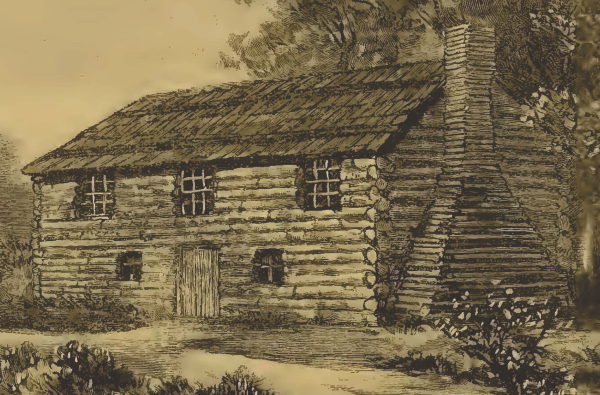 |
William Tennents's Log College (1726-1746) |
William Tennent established his school to train Ministers according to the New England Way. The Log College was the only school in the colonies designed to educate pro-revival Presbyterian ministers leading up to, and during the First Great Awakening. In 1739, the Presbyterian governing body, told Tennent his students would not be considered as pastors in Presbyterian churches. This was a move to quash the First Great Awakening by the anti-revival forces. The anti-revival establishment held that ministers must be educated at established elite universities in Europe (like Edinburgh or Glasgow) or New England (like Harvard or Yale). These universities downplayed or ignored the Biblical view of salvation as being the result of supernatural regeneration and the indwelling of the Holy Spirit. The universities in Scotland taught rationalism, and later, Scottish Common Sense Realism, which explained regeneration as the "tipping point of the understanding" and held the Holy Spirit was limited in how he could save sinners, as defined in the "verbal restrictive" theory. Harvard and Yale also taught rationalism, and considered the New England Way to be antiquated and unfashionable, and discouraged young ministers from participating in the First Great Awakening. For example, David Brainerd was expelled from Yale in 1742 for expressing pro-revival sentiments In 1752, William Tennent sent his oldest son Gilbert with Samuel Davies to London, England to raise money for the College of New Jersey, so there would be at least one school that could produce pro-revival ministers who would be accepted by churches. The Log College had been starved to death by Old Light Calvinist ministers and congregations who did not accept its graduates as qualified ministers. It is unfortunate that all the efforts of pro-revival ministers like Jonathan Edwards, William Tennant, Gilbert Tennent, Jonathan Dickinson, Aaron Burr Senior, Samuel Davies and Samuel Finney and John Blair to make the College of New Jersey a pro-revival school were thrwarted with the arrival of John Witherspoon as president of the College in 1768. |
 |