
How The Nathan Lewis Rice
Versus Alexander Campbell Debates
Relate to
the
Heresy of
Decisional Regeneration
 |
 |
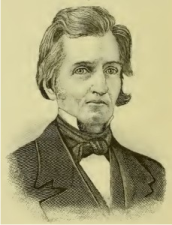
Nathan Lewis Rice (1807-1877) |
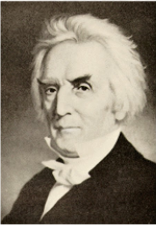
Alexander Campbell (1788-1866) |
Nathan Lewis Rice (1807-1877) was a Presbyterian minister who trained at Princeton Theological Seminary. He is most famous for his debate with Alexander Campbell on the subject of baptism. But the debate that best explains the similarities between Campbell's Scottish Common Sense Realism learned at Glasgow University and Rice's Scottish Common Sense Realism learned at Princeton Theological Seminary is the 5th debate called In conversion and sanctification, the Spirit of God operates on persons only through the word of truth. Mr. Campbell affirms. Mr. Rice denies.
The debate was held in Lexington, Ky. The moderators consisted of some of the most eminent lawyers of the state, among, whom was Henry Clay. This discussion created a wide and intense interest throughout the country, and brought out the full power of Dr. Rice as a disputant, and gained for him the reputation of being the greatest polemic of the age. The debate was written out by the disputants and published in a large octavo volume, which was extensively circulated.
Alexander Campbell was educated at the University of Glasgow, Scottland, and as such, indoctrinated with the salvation theology of Scottish Common Sense Realism, the 18th century salvation theology of the Presbyterian Church. He also believed the Rational Faith views of John Locke. At age 21, he emigrated to the United States in 1809.
With his father Thomas, he began their movement in 1809 with the publication of Thomas Campbell's Declaration and Address of the Christian Association of Washington (Washington County, Pennsylvania). In 1811, the Association established itself as the Brush Run Church. They called themselves "Disciples of Christ" to distinguish from the Baptists with whom they fellowshipped.
In fact, Alexander Campbell published a magazine called "The Christian Baptist" from 1823-1830. Because Campbell denied supernatural regeneration and the indwelling of the Holy Spirit, and told Baptists all they had to do to be saved was be baptized in water, many Baptist Associations started to expell church members that associated with the Restorationist movement. You can read one of thes Baptist Circular Letters that warned against Campbellism, published in July 1830.
In 1830, Alexander Campbell's Consistently Published view (and the majority opinion of Restorationists), was The Verbal-Restrictive theory, that is,
The work of the Holy Spirit is imminent (restricted to, but fully available) in the word of Scripture. The means of salvation are therefore restricted to hearing and reading scripture. Campbell wrote, “Whatever the word does, the Spirit does; and whatsoever the Spirit does in the work of converting men, the word does.”
But when confronted with this quote from The Christian System in a debate in 1843 with Nathan Lewis Rice, Campbell said he was NOT a strict “Verbal-Restrictivist”, and that he believed in some way the Spirit quickened scripture in the heart, which should have silenced Rice, because that sounds like the Scottish Common Sense Realism taught at Princeton Theological Seminary. Rice would have called it the "truth-impression" theory. Campbell's church called it the Verbal-Augmentative theory.
A good explanation of the "truth Impression" theory of Scottish Common Sense Realism was given By Archibald Alexander in commenting on the teaching of his mentor, William Graham. Notice the red comment.
"One of his radical principles was that the rational soul of man can undergo no moral change, except through the influence of motives, or the presentation through the understanding of such objects as excite the affections. He therefore scouted (refused to believe in) the opinion that in regeneration
there is any physical operation on the soul itself, and held that by the influence of the Holy Spirit truth is presented in its true nature to the rational mind, and when thus perceived cannot but (this is the “must” of Scottish Common Sense realism that was the beginning of the heresy of decisional regeneration which required no immediate change of character) produce an effect correspondent with its nature."
"He therefore fully held what has been called in some places the 'light-scheme' believing that all moral changes must be produced by new views, and can be produced in no other way. But how the dead soul could have truth thus presented to it, without being first vivified, he did not explain. In effect, however, he held with those who believe that all moral acts and exercises are produced by the operation of the truth, justly apprehended, but that in order to this a regenerating influence must be sent forth to render the soul capable of such views of truth as will produce these effects."
"Regenerating influence" is a sop to the Holy Spirit being necessary as a metaphysical "energizing" influence on the mind, so there can be a "truth impression" on the mind, as later explained by Archibald Alexander:
"There are two kinds of religious knowledge, which though intimately connected as cause and effect, may nevertheless be distinguished. These are the knowledge of the truth as it is revealed in the Holy Scriptures, and the impression which that truth makes on the human mind when rightly apprehended. The first may be compared to the inscription or image on a seal; the other to the impression made by the seal on the wax. "
“genuine religious experience is nothing but the impression of divine truth on the mind, by the energy of the Holy Spirit”.
To the simple-minded, this seems to relieve God of the responsibilty of supernatural regeneration (change of character). But this is an illusion. Alexander took an analogy which is static, and applied it to the human mind, which is changing. Alexander did the same thing Finney did with his separation of Moral Law from Physical Law, taking a philosophical abstraction, and saying it applies to reality, as illogical as saying thoughts are separate from thinking.
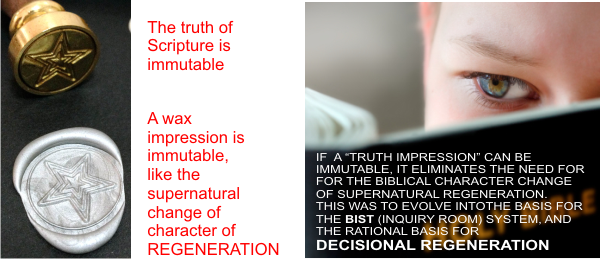
The immutability of a "truth impression" is saying that the soul, once illuminated, is forever changed, something emphatically stated by Witherspoon. Regeneration became nothing more than a soul that had been morally persuaded. This, of course, is like saying that blind men can see if given enough light, something contrary to Calvin's view that sinners are completely blind until God supernaturally gave them sight.
The immutability of a supernaturally changed (regenerated) nature taught by previous generations of Calvinists was transfered to the immutability of a morally persuaded rational mind of the Scottish Common Sene Realists.
Rice (educated at Princeton theological seminary in Scottish Common Sense Realism) and Campbell, educated at Glascow Seminary in Scottish Common Sense Realism, both has a psychological view of salvation with minor differences.
Scottish Common Sense Realists did not believe the Holy Spirit manifested Himself immediately in the First and Second Great Awakenings. They thought all events that were thought to be supernatural were manifestations of human being "animal nature". Like the Sadducees, they believed that the immediate activity of spirits (including the Holy Spirit) ceased in the Bible times that happened before their age. The Sadducees thought the Holy Spirit ceased to communicate with man immediately when the first 5 books of the Bible were completed.
The Scottish Common Sense Realists thought the Holy Spirit ceased communicating with man immediately after the Book of revelation was completed. There is no record of a Sadducee ever being saved... they could not believe, "my speech and my preaching was not with enticing words of man's wisdom, but in demonstration of the Spirit and of power: That your faith should not stand in the wisdom of men, but in the power of God' (1 Corinthians 2:4-5), just as the Scottish Common Sense Realists could not believe the unusual events that happened in connection with Whitefield, Wesley, and many other ministers were supernatural manifestations of the Holy Spirit.
The Old Lights refused to acknowledge “religious affections” as genuine because they thought they were disruptive to church order. The New Lights started new churches. Many of the Old Lights ultimately became Universalists. The Presbyterians were a middle group that had a state church salvation theology similar to the Old Lights, but their reason for not believing in the immediate activity of the Holy Spirit was not based on not allowing disorder like the Old Lights. The Scottish Common Sense Realists didn't allow for the immediate activity of the Holy Spirit because it was not empirical. Scottish Common Sense Realism salvation does not allow for any activity of the Holy Spirit that can not be explained empirically. This eliminates supernatural regeneration and the indwelling of the Holy Spirit.
Here is the debate:
RULES FOR DEBATE.
The following rules governed the entire discussion:
1. The debate shall commence on Wednesday, November 15, 1843.
2. To be held in the Reform Church.
3. Judge Robertson, selected by Mr. Rice, as Moderator. Col. Speed Smith, selected by Mr. Campbell and agreed that these two shall select a President Moderator. In case of either of the above-named gentlemen declining to act, Judge Breck was selected by
Mr. Rice as alternate to Judge Robertson, and Colonel Caperton as alternate to Col. Speed Smith.
4. In the opening of each new subject the affirmant shall occupy one hour, and the respondent the same time; and each thereafter half hour alternately to the termination of each subject. The debate shall commence at 10 o'clock A.M., and continue until 2 o'clock
P.M., unless hereafter changed.
5. On the final negative no new matter shall be introduced.
6. The propositions for discussion are the following:
I. The immersion in water of a proper subject, into the name of the Father, Son, and of the Holy Spirit, is the one, only apostolic or Christian baptism. Mr. Campbell affirms. Mr. Rice denies.
II. The infant of a believing parent is a Scriptural subject of baptism. Mr. Rice affirms. Mr. Campbell denies.
III. Christian baptism is for the remission of past sins. Mr. Campbell affirms. Mr. Rice denies.
IV. Baptism is to be administered only by a bishop or ordained Presbyter. Mr. Rice affirms. Mr. Campbell denies.
V. In conversion and sanctification, the Spirit of God operates on persons only through the word of truth. Mr. Campbell affirms. Mr. Rice denies.
VI. Human creeds, as bonds of union and communion, are necessarily heretical and schismatical. Mr. Campbell affirms. Mr. Rice denies.
6. No question shall be discussed more than three days, unless by agreement of parties.
7. Each debatant shall furnish a stenographer.
8. It shall be the privilege of the debaters to make any verbal or grammatical changes in the stenographer's report, that shall not alter the state of the argument, or change any fact.
9. The net available amount, resulting from the publication, shall be equally divided between the two American Bible Societies.
10. The discussion shall be conducted in the presence of Dr. Fishback, President Shannon, John Smith, and A. Raines, on the part of the Reformation ; and President Young, James K. Burch, J. F. Priee, and John H. Brown, on the part of the Presbyterianism.
11. The debatants agree to adopt as "rules of decorum" those found in Hedges' Logic, p. 159, to-wit:

Rule I. The terms in which the question in debate is expressed, and the point at issue, should be clearly defined, that there could be no misunderjstanding respecting them.
Rule 2. The parties should mutually consider each other as standing on a footing of equality, in respect to the subject in debate. Each should regard the other as possessing equal talents, knowledge, and a desire for
truth with himself; and that it is possible, therefore, that he may be in the wrong, and his adversary in the right.
Rule 3. All expressions which are unmeaning, or without effect in regard to the subject in debate, should be strictly avoided.
Rule 4. Personal reflections on an adversary should, in no instance, be indulged.
Rule 5. The consequences of any doctrine are not to be charged on him who maintains it, unless he expressly avows them.
Rule 6. As truth, and not victory, is the professed object of controversy, whatever proofs may be advanced, on either side, should be examined with fairness and candor ; and any attempt to answer an adversary by arts of sophistry, or to lessen the force of his
reasoning by wit, cavilling or ridicule, is a violation of the rules of honorable controversy.
(Signed.) A. Campbell, N. h. Rice.
CAMPBELL- RICE DEBATE.
MR. CAMPBELL'S OPENING ADDRESS.
Monday, Nov. 27, 10 AM.
Mr. President. — The proposition to be discussed to-day is admitted on all hands to be of transcendent importance to the Christian. It is expressed in the following words: "In conversion and sanctification, the spirit of God operates on persons only through the Word." Most controversies are mere logomachies — wars of words about words, and not about things. Perspicuity and precision in the definition of the terms of a proposition at the commencement, would have prevented more than half of all the debates in the world, and would have reduced the other half to less than half their size. Indeed, we yet need for daily use a much more simple and Scriptural vocabulary, on the great subject of religion, as well as in some other departments of literature and science. The cumbrous, unwieldy, and badly assorted nomenclature of certain sciences has, for centuries, retarded their progress.
This is most unfortunately true in the intellectual and moral departments. Scholastic theology is greatly behind the age. The stale divinity of other times refuses to reconsider its sense or its symbols. Hence the superabundance of the barbarous gibberish and miserable Jargon yet extant in our creeds and systems of theoretic divinity. Some samples of these quaint vocables may be given in the discussion of the creed question. Meantime, we have yet to learn how much perversion, not of language only, but of tlie mind also, has grown out of sectarian animosities and bickerings.
The periodical hobbies of religious parties generate, like our political feuds, hosts of new terms ; and often change and modify the old ones, that even a well practiced politician, with Johnson, and Webster, and Richardson by his side, can not nowadays define, either Whig or Tory. Democrat or Republican. It is truly an interesting study to learn the new phraseology of religion — not only of religion in general, but of the different leading parties of the present church militant. An adept in this study could almost swear to a Romanist or a High Churchman, a Presbyterian of a Methodist, in the dark, if he only heard him speak for a single hour; and that, too, without stating one of his peculiar dogmata.
Certain words, like the shibboleth of the Ephraimites. invariably identify the religious tribe to which the speaker belongs. In the midst of this babelism there is one fact which it behooves me to state.' I scarcely know how. indeed, to introduce it in this place; and yet it is essential to a proper understanding of the whole subject before us.
This fact is, that, in the strife of partyism, some Bible terms have been so appropriated to represent peculiar tenets and views which never occurred to their inspired authors; that, were Paul now living amongst us, he could not understand much of his own language. To this class belong the words "regeneration," "sanctification, and ''conversion." With special reference to the discussion, and to the words of my proposition, I must, therefore, notice one capital blunder, which, if not now detected, might involve the subject before us in great obscurity. I can not, however, much as I regret it, distinctly unfold my meaning in a single sentence. Allow me, then, to open it gradually to the apprehension of all.
The various conditions of man, as he was, as he now is, and as he shall hereafter be, as connected with Adam the first, and Adam the second, are set forth in Sacred Scripture, under various images and metaphors, each of which belongs exclusively to its own class, and is independent of every other one ; requiring no addition or subtraction of other images, from other classes, to complete or to unfold it. For example, the present condition of sinners, in Adam the first, is set forth under such metaphors as the following: dead, destroyed, lost, alienated, enemy, going astray, condemned in law, debtor, unclean, sold to sin, darkened, blind, etc. Each one of these has a class of opposite metaphors, of the same particular idea or figure. These metaphors, just now quoted, give rise to a corresponding class, indicative of his new condition in Adam the second, such as quickened, made alive, born again, new created, saved, reconciled, friend, converted, illuminated, pardoned, redeemed, etc.
The changing of these states is also set forth in suitable imagery, such as regeneration, conversion, reconciliation, new creation, illumination, remission, adoption, redemption, salvation, etc. Now, the error to which I allude, primarily, consists in not uniformly regarding each one of these as a complete view of man, in some one condition, or in his whole condition in Adam the first, or in Adam the second; but in sometimes contemplating them as parts of one view, as fractions of one great whole, and, consequently, to be all added up to make out a full Scriptural view of man, in Adam and in Christ, and of the transition from the one state to the other.
From this wild confusion of metaphors — the indiscriminate use of certain leading terms, mere images it may be — our very best and most admired treatises on theology are not always exempt. Hence regeneration, conversion, justification, sanctification, etc., etc., are frequently represented as component parts of one process; 1 whereas, any one of these, independent of the others, gives a full representation of the subject. Is a man regenerated? he, is converted, justified, and sanctified. Is he sanctified? he is converted, justified, and regenerated. With some system-builders, however, regeneration is an instantaneous act, between which and conversion there is a positive, substantive interval; next comes justification; and then, in some still future time, sanctification.
A foreigner, in becoming a citizen, is sometimes said to be naturalized, sometimes enfranchised, sometimes adopted, sometimes made a citizen. Now, what intelligent citizen regards these as parts of one process? Rather, who does not consider them as different metaphors, setting forth the same great change under various allusions to past and present circumstances? From such a statement none but a simpleton would imagine that a foreigner was first naturalized, then enfranchised, then adopted, and finally made an American citizen; yet such a simpleton is that learned rabbi, who represents a man first regenerated, then converted, then justified, then sanctified, then saved.
Under any one of these images, various distinct acts of the mind, or of the whole person of an individual, may be necessary to the completion of the predicate concerning him. Thus, in regeneration or conversion there may be included hearing, believing, repenting, and being baptized. These are connected as cause and effect, under a fixed administration or economy of salvation. So Paul asks, "How shall they call upon him in whom they have not believed? How shall they believe in him of whom they have not heard? — and how shall they hear without a preacher? — and how shall they preach unless they be sent?"
The terms of my proposition will now be easily defined and apprehended. Conversion is a term denoting that whole moral or spiritual change, which is sometimes called sanctification, sometimes regeneration. These are not three changes, but one change indicated by these three terms, regeneration, conversion, sanctification. Whether we shall call it by one or the other of these depends upon the metaphor we happen to have before us, in contemplating man as connected with the two Adams — the old or the new,
the first or the second, the earthly or the heavenly. Is he dead in the first? — then he is born again and alive in the second. Has he, like the prodigal son, strayed away in the first? — he returns, or is converted in the second. Is he unclean or polluted in the earthly Adam? — he is sanctified in the heavenly. Is he lost in the first? — he is saved in the second. Is he destroyed and ruined in the first ? — he is created anew in the second Adam, the Lord from heaven.
If I am asked, why I admitted the terms conversion, sanctification, or regeneration into the proposition, I answer again, I could not help it. It would have been to debate the question while settling the preliminaries. We must take the religious world as we have to take the natural or the political: that is, just as we find them, or as they find us. I seek to accomplish in this preamble, what ought to have been, but which could not be, accomplished in settling the propositions. I therefore now most distinctly and emphatically state, that with me, and in reference to this discussion, these terms, severally and collectively, indicate a moral, a spiritual, and not a physical nor legal change.
A physical change has respect to the essence or form of the subject. A legal change is a change as respects a legal sentence, or enactment. Hence pardon, remission, justification, have respect to law. But a moral or spiritual 2 change is a change of the moral state of the feelings, and of the soul. In contrast with a merely intellectual change, a change of views, it is called a change of the affections, a change of the heart.
It is in this acceptation of the subject of my proposition that I predicate of it, "The Spirit operates only through the Word." 3
The term only is indeed redundant, because a moral change is effected only by motives, and motives are arguments; and all the arguments ever used by the Holy Spirit are found written in the book called the Word of Truth. Hence, the term is only equivalent to a denial of what I conceive to be the assumption of my respondent, viz., that the Spirit in regeneration operates sometimes without the Word. 4 Only is, therefore, by the force of circumstances, made to mean always. But, indeed, this is more a matter of form than of any grave importance, inasmuch as the common admission of Protestants, and, I presume, of my opponent also, is, that the change of which we speak is a moral or spiritual change.
If, then, I prove that conversion, or sanctification. is effected by the Word of Truth at all, I prove that it is a moral change, and, consequently, accomplished by the Holy Spirit, through the Word alone.
On the subject of spiritual influence there are two extremes of doctrine. There is the Word alone system, and there is the Spirit alone system. I believe in neither. The former is the parent of a cold, lifeless rationalism and formality. The latter is, in some temperaments, the cause of a wild, irrepressible enthusiasm; and, in other cases, of a dark, melancholy despondency. With some there is a sort of compound system, claiming both the Spirit and the Word — representing the naked Spirit of God operating upon the naked soul of man, without any argument, or motive, interposed in some mysterious and inexplicable way — incubating the soul, quickening, or making it spiritually alive, by a direct and immediate contact, without the intervention of one moral idea, or impression.
But, after this creating act, there is the bringing to bear upon it the gospel revelation, called conversion. Hence, in this school, regeneration is the cause; and conversion, at some future time, the result of that abstract operation.
There yet remains another school, which never speculatively separates the Word and the Spirit; which, in every case of conversion, contemplates them as cooperating; or, which is the same thing, conceives of the Spirit of God as clothed with the gospel motives and arguments — enlightening, convincing, persuading sinners, and thus enabling them to flee from the wrath to come. In this school conversion and regeneration are terms indicative of a moral or spiritual change — of a change accomplished through the arguments, the light, the love, the grace of God expressed and revealed, as well as approved by the supernatural attestations of the. Holy Spirit. They believe, and teach, that it is the Spirit that quickens, and that the Word of God — the Living Word — is that incorruptible seed, which, when planted in the heart, vegetates, and germinates, and grows, and fructifies into eternal life. They hold it to be unscriptural, irrational, unphilosophic, to discriminate between spiritual agency or instrumentality — between what the Word, per se, or the Spirit, per se, severally does; as though they were two independent and wholly distinct powers or influences. They object not to the co-operation of secondary causes; of various subordinate instrumentalities; the ministry of men; the ministry of angels; the doctrine of special providences; but, however, whenever the Word gets into the heart — the spiritual seed into the moral nature of man — it as naturally, as spontaneously, grows there as the sound, good corn, when deposited in the genial earth. It has life in it, and is, therefore, sublimely and divinely called "The Living and Effectual Word." 5
I prefer the comparisons of the Great Teacher. They are the most appropriate. We frequently err when handling these, because, in our quest of forbidden knowledge we are disposed to carry them farther than he himself did. In the opening parable of the Gospel Age — a parable placed first in the synopsis of parables presented by Matthew, Mark, and Luke — he thus compares the Word of God to seed; and, with reference to that figure, he compares the human heart to soil, distributed into six varieties: the trodden pathway, the rocky field, the thorny cliff, the rich alluvian, the better, and the best of that. But we are not content with that beautiful and instructive representation of the philosophy of conversion. We must transcend these limits. We must explain the theory of vegetation. We must explain the theory of soils. We must even become spiritual geologists, and explore all the strata of mother earth; and even then there yet remains an infinite' series of whys and herefores concerning all the reasons of things connected with these varieties.
These speculations, and the conflicting theories to which they have given birth, we will and bequeath to the more curious and speculative, and will farther premise some things necessary to a proper opening of the argument.
Man, by his fall or apostasy from God, lost three things — union with God, original righteousness, and original holiness. In consequence of these tremendous losses he forfeited life, lost the right of inheriting the earth, and became subject to all the physical evils of this world. He is, therefore, with the earth on which he lives, doomed to destruction; meanwhile, a remedial system is introduced, originating in the free, sovereign, and unmerited favor of God; not, indeed, to restore man to an Eden lost — to an inheritance forfeited — to a life enjoyed before his alienation from his divine Father and Benefactor. This supremely glorious and transcendent scheme of Almighty love contemplates a nearer, more intimate, and more sublime union with God than that enjoyed in ancient paradise — a union, too, enduring as eternity, as indestructible as the divine essence.
It bestows on man an everlasting righteousness, a perfect holiness, and an enduring blessedness in the presence of God for ever and ever. To accomplish this a new manifestation of the Divinity became necessary. Hence the development of a phirality of existence in the Divine Nature. The God of the first chapter of Genesis is the Lord God of the second. Light advances as the pages of human history multiply, until we have God, the Word of God, and the Spirit ot God clearly intimated in the law, the prophets, and the Psalms. But it was not until the Sun of Righteousness arose — till the Word became incarnate and dwelt among us — till we beheld his glory as that of an only begotten of the Father, full of grace and truth; it was not till Jesus of Nazareth had finished the work of atonement on the hill of Calvary — till he had brought life and immortality to light, by his revival and resurrection from the sealed sepulcher of the Arjniathean senator; it was not till he gave a commission to convert the whole world that the development of the Father, and of the Son, and of the Holy Spirit was fully stated and completed. Since the descent of the Holy Spirit, on the birthday of Christ's Church — since the glorious immersion of the three thousand triumphs of the memorable Pentecost, the Church has enjoyed the mysteries and sublime light of the Father, and of the Son. and of the Holy Spirit, as one Divinity, manifesting itself in these incomprehensible relations, in order to effect the complete recovery and perfect redemption of man from the guilt, the pollution, the power, and the punishment of sin.
No one, Mr. President, believes more firmly than I, and no one, I presume, endeavors to teach more distinctly and comprehensively than I, this mysterious, sublime, and incomprehensible plurality and unity in the Godhead. It is a relation that may be apprehended by all, though comprehended by none. It has its insuperable necessity in the present condition of the universe. Without it, no one can believe in, or be reconciled to, the remedial policy, as developed in the apostolic writings. And, sir, I have no more faith in any man's profession of religion, than I have in the sincerity of Mahomet, who does not believe in the Father, and in the Son. and in the Holy Spirit as cooperating in the illumination, pardon, and sanctification of fallen, sinful, and degraded man. While, then, I repudiate, with all my heart, the scholastic jargon of the Arian, Unitarian and Trinitarian hypotheses, I stand up before heaven and earth in defense of the sacred style — in the fair, full and perfect comprehension of all its words and sentences, according to the canons of a sound, exegetical interpretation.
I would not, sir, value at the price of a single mill the religion of any man, as respects the grand aflfair Influence of the Holy Spirit of eternal life, whose religion is not begun, carried on, and completed by the personal agency of the Holy Spirit. Nay, sir, I esteem it the peculiar excellence and glory of our religion, that it is spiritual; that the soul of man is quickened, enlightened, sanctified and consoled by the indwelling presence of the Spirit of the eternal God. But, while avowing these, my convictions, I have no more fellowship with those false and pernicious theories that confound the peculiar work of the Father with that of the Son, or with that of the Holy Spirit, or the work of any of these awful names with that of another; or which represents our illumination, conversion and sanctification as the work of the Spirit without the knowledge, belief and obedience of the Gospel, as written by the holy apostles and evangelists, than I have with the author and finishers of the Book of Mormon. 6
The revelation of Father, Son, and Holy Spirit is not more clear and distinct than are the different offices assumed and performed by these glorious and ineffable three in the present affairs of the universe. It is true, so far as unity of design and concurrence of action are contemplated, they co-operate in every work of creation, providence and redemption. Such is the concurrence expressed by the Messiah in these words, "My Father worketh hitherto, and I work,""I and my Father are one," "Whatsoever the Father doeth. the Son doeth likewise"; but not such a concurrence as annuls personally, impairs or interferes with tlie distinct offices of each in the salvation of man.
For example, the Father sends his Son, and not the Son his Father. The Father provides a body and a soul for his Son, and not the Son for his Father. The Son offers up that body and soul for sin, and thus expiates it, which the Father does not, but accepts it. The Father and Son send forth the Spirit, and not the Spirit either. The Spirit now advocates Christ's cause, and not Christ his own cause. The Holy Spirit now animates the Church with his presence, and not Christ himself. He is the Head of the Church, while the Spirit is the heart of it. The Father originates all, the Son executes all, the Spirit consummates all. Eternal volition, design and mission belong to the Father; reconciliation to the Son; sanctification to the Spirit. In each of these terms there are numerous terms and ideas of subordinate extent, to which we can not now advert. At present, we consider the subject in its general character, and not in its particular details.
In the distribiition of official agency, as it presents itself to our apprehension, with reference to 'he subject before us, we regard the benevolent design and plan of man's redemption, as originating in the bosom of our Divine Father; the atonement, or sacrificial ransom, as the peculiar work of the Messiah; and the advocacy of his cause, in accomplishing the conversion and sanctification of the world, the peculiar mission and office of the Holy Spirit. Thus, the Spirit is the author of the written Word, as much as Jesus Christ is the author of the blood of atonement. The atoning blood of the everlasting covenant is not more peculiarly the blood of Jesus Christ than is the Bible the immediate work of the Holy Spirit, inspired and dictated by him: "For holy men of old spake as they were moved by the Holy Spirit."' Now, as Jesus, the Messiah, in the work of mediation, operates through his blood, so the Holy Spirit, in his official agency, operates through his Word and its ordinances. And thus we have arrived at the proper consideration of pur proposition, to-wit: In conversion and sanctificaton the Holy Spirit operates only through the Word of Truth. 7
In how many other ways the Spirit of God may operate in nature, or in society, in the way of dreams, visions and miracles, comes not within the premises contained in our proposition. To what extent he may operate in suggestions, special providences, or in any other way, is neither affirmed nor denied in the proposition before us. It has respect to conversion and sanctification only. Whatever ground is fairly covered by these terms belongs to this discussion. What lies not within these precincts comes not legitimately into this debate.
I. Our first argument in proof of our proposition shall be drawn from the constitution of the human mind. That the human mind has a specific and well-defined constitution is as evident as that the body has a peculiar organization; or that the universe itself has one grand code of laws which govern it. Our intellectual and moral constitution, as well as our physical, has its peculiar powers and capacities, not one of which is violated on the part of our Creator in his remedial administration, any more than are our sensitive and animal faculties destroyed or violated by the physician who rationally and benevolently aims at our restoration to health from some physical malady. No new faculties are imparted — no old faculty destroyed.
They are neither more nor less in number; they are neither better nor worse in kind. Paul, the apostle, and Saul of Tarsus are the same person, so far as all the animal, intellectual and moral powers are concerned. His mental and physical temperament were just the same after as before he became a Christian. The Spirit of God, in effecting this great change, does not violate, metamorphose, or annihilate any power or faculty of the man in making the saint. He merely receives new ideas, and new impressions, and undergoes a great moral or spiritual 8 change, so that he becomes alive wherein he was dead, and dead wherein he was formerly alive.
As the body or outward man has its peculiar organization, so has the mind. Both are organized in perfect adaptation to a world without us: the one to a world of sensible and material objects, the other to that of the world, and to a spiritual system also, with which it is to have perpetual intimacy and communion. But the mind is to commune with its Creator, and its Creator with it, through material as well as through spiritual nature; and for this purpose he has endowed it with faculties, and the body with senses favorable to these benevolent designs.
Now, as the body has to subsist upon material nature, and the mind upon the spiritual system, both are so organized and furnished as to secure and assimilate so much of both as are necessary for this end. Thus, for example, the body lives, moves, and has its being in the midst of matter from which it is to draw perpetual sustenance and comfort. For doing this it is admirably fitted with an animal machinery, created for this purpose, without which animal life would immediately become extinct. The lungs are fitted for respiration, and the stomach is furnished with all the powers necessary to the reception, digestion, and assimilation of so much of material nature as is necessary to the healthful, vigorous and comfortable subsistence of the body. But nothing from without can afford it subsistence or comfort but in harmony with this organization.
Man, then, has to live by breathing, eating, and drinking; and without these operations nothing around him can afford him life and comfort. Nothing of the bounties of nature can administer to his animal enjoyments in any other way. God, then, feeds and sustains man in perfect harmony with this organization. He neither dispenses with any of these powers nor violates them in supporting physical life and comfort.
Precisely so is it in the spiritual system. The mind has its powers of receiving, assimilating and enjoying whatever is suitable to itself, as the body with which it is furnished. While embodied, it has only its own proper faculties, but it has also organs and senses in the body, by and through which it communes with matter and with spirit, with God, and nature, and man; and through which they commune with it. It receives all the ideas of material nature by outward, bodily sense, without which it could not have one idea or impression of the external universe. A blind man has no idea of colors, nor a deaf man of sounds. Neither can any one give him an idea of them without those senses. Since the world began, every man sees by his eyes and hears by liis ears. Whatever knowledge, therefore, is peculiar to any sense can never be acquired by another. If God give sight to the blind, or hearing to the deaf, he does it by restoring these senses; for, since the world began, no man has ever seen by his ears nor heard by his eyes.
So true it is, that all our ideas of the sensible universe are the result of sensation and reflection. All the knowledge we have of material nature has been acquired by the exercise of our senses and of our reason upon those discoveries. With regard to the supernatural knowledge, or the knowledge of God, that comes wholly "by faith," and "faith" itself "comes by hearing." This aphorism is Divine. Faith is, therefore, a consequence of hearing, and hearing is the effect of speaking; for, hearing comes by the Word of God spoken, as much as faith itself comes by hearing. The intellectual and moral arrangement is, therefore: (1) the word spoken; (2) hearing; (3) believing; (4) feeling; (5) doing. 9 Such is the constitution of the human mind — a constitution divine and excellent, adapted to mans position in the universe. It is never violated in the moral government of God. Religious action is uniformly the effect of religious feeling; that is the effect of faith; that of hearing ; and that of something spoken by God.
Now, as faith in God is the first principle — the soul-renewing principle of religion; as it is the regenerating, justifying, sanctifying principle; without it, it is impossible to be acceptable to God. With it, a man is a son of Abraham, a son of God; an heir apparent to eternal life — an everlasting kingdom. And what is Christian faith? It is a belief of testimony. It is a persuasion that God is true; that the gospel is divine; that God is love; that Christ's death is the sinner's life. It is trust in God. It is a reliance upon his truth, his faithfulness, his power. It is not merely a cold assent to truth, to testimony; but a cordial, joyful consent to it, and reception of it.
Still, it is dependent on testimony. No testimony, no faith. The Spirit of God gave the testimony first. It bore witness to Jesus. It expected no faith without something to believe. Something to believe is always presented to faith; and that something must be heard before it can be believed; for, until it is heard, it is as though it were not — a nonentity. But it is not enough that it be heard by the outward ear. God has given to man an inward, as well as an outward ear.
The outward recognizes sounds only; the inward recognizes sense. Faith is, therefore, impossible without language, and consequently without the knowledge of language, and that language understood. It is neither necessary nor possible without language — intelligible language. An infant can not have faith; but it needs neither faith, nor regeneration, nor baptism. It was a figment of St. Augustine, adopted by Calvin, propagated in his Institutes and adopted by his children.
These infant regenerations are lame in both limbs — in the right limb of faith and in the left limb of philosophy. They move on crutches, and broken crutches, too. They have no philosophy of mind, or else they abandon it in all their theological embarrassments. They will have infants regenerated, and souls morally dead quickened by a direct impulse. The Spirit of God is supposed to incubate their souls — to descend upon them and work a grace in them — a faith without reason, without argument, without evidence, without intelligence, without perception, without fear, hope, love, confidence or approbation.
The whole system cf Calvinism, of Arminianism, is crazy just at this point. They build a world upon the back of a tortoise, they pile mountains upon an egg. They build palaces upon ice, and repose on couches of ether. They have not one clear idea on the subject of regeneration. It is to them a mystic mystery, a cabalistic word, a mere shibboleth. The philosophy of mind is converted into a heap of ruins. They have the Spirit of God operating without testimony, without apprehension or comprehension, without sense, susceptibility or feeling; and all this for the sake of an incomprehensible, unintelligible, and worse than useless theory. I therefore, exanimo, repudiate their whole theory of mystic influence and metaphysical regeneration as a vision of visions, a dream of dreams, at war wiih philosophy, with the philosophy of mind, with the Bible, with reason, with common sense, and with all Christian experience. 10
II. — Our second argument is deduced from the fact that no living man has ever been heard of, and none can now be found, possessed of a single conception of Christianity, of one spiritual thought, feeling or emotion, where the Bible, or some tradition from it, has not been before him. Where the Bible has not been sent, or its traditions developed, there is not one single spiritual idea, word or action. It is all midnight — a gloom profound — utter darkness. What stronger evidence can be adduced than this most evident and indisputable fact? It weighs more than a thousand volumes of metaphysical speculations.
One would m.ost rationally conclude that if the Spirit of God did anywhere illuminate the human mind, or work into the heart the principle of faith previous to, and independent of, any knowledge of the Holy Scriptures, he would most probably do it in those portions of the earth and amid those vast masses of human kind entirely destitute of the Word of Life — A wholly ignorant of the "only name given under the whole heaven" by which any sinful man can be saved. If, then, he has never operated in this way, where the Bible has never gone, who can prove that he so operates here, where the Bible is enjoyed.
When, then, we reflect upon the melancholy fact so often pressed upon the attention of Christendom, by her missionaries to heathen lands, that not more than one-third of human kind enjoy the name of Jesus; that six-tenths or seven-tenths of mankind are wholly given up to the most stupid idolatries or delusions; that pagan darkness and Mahometan impostures cover the fairest and largest portions of our earth, and engulf the great majority of our race in the most debasing superstitions, in the grossest ignorance, sensuality, and vice; and that from these is withholden all spiritual and divine influence of a regenerating and salutary character, so far as all documentary evidence avoucheth, — if, then, indeed, the Spirit of the Bible, the Holy Spirit of our God, did at all travel out of the record and work faith, or communicate intelligence, without verbal testimony, methinks this is the proper field. And there being no evidence of his having so done, is it not a fact as clear as revelation from heaven, clear as demonstration itself, that the illuminating, regenerating, converting, sanctifying influences of the Spirit of Wisdom and Revelation are not antecedent to, nor independent of, the written oracles of that Spirit?
III. — Our third argument is deduced from the fact that no one professing to have been the subject of the illuminating, converting and sanctifying operations of the Spirit of God can ever express a single right conception or idea on the whole subject of spiritual things, not already found in the written Word. We have been favored with numerous revelations of the experiences of the most spiritually minded and excellent Christians of this, our age. And on listening to them with the strictest attention, marking, with all our powers of discrimination, every idea, sentiment and expression as uttered, I have never heard one suggestion containing the feeblest ray of light which was not eighteen hundred years old, and already found in the Holy Scriptures — read of all men who choose to learn what the Spirit of God has said to saints and sinners. Evident, then, it is, from this fact, which, I presume, I may also call an incontrovertable fact, that no light is communicated by the Holy Spirit in regenerating and converting men; which is equivalent to saying that in conversion and sanctification the Spirit ot God operates only through the Word of Truth.
IV. — My fourth argument is derived from another fact which calls for special consideration just at this point, to-wit, whether it is essential to regeneration in any case is essential to it in all cases. The change, called regeneration, is a specific change. It consists of certain elements, and is effected by a special agency. If it be a new heart given, a new life communicated, it is accomplished in all cases, as generation is, by the same agency and instrumentality. If, then, the Spirit of God, without faith, without the knowledge of the Gospel, in any case regenerates an individual, he does so in all cases. But if faith in God, or a knowledge of Christ, is essential in one case, it is essential in every other case.
Now this being admitted, as I presume it will be, without farther argument or illustration, follows it not then that neither the Word of God, nor the Gospel of Christ, either preaching nor teaching, neither hearing nor believing is necessary to regeneration, according to the doctrine of the Presbyterian Church? — inasmuch as that church believes and teaches that infants and pagans are regenerated, in some cases, without any instrumentality at all, but by the direct, naked and abstract influence of the Spirit of God operating immediately upon their souls. As this is a most essential affair in this discussion, it is all-important that we deliver ourselves in the very words of the Church, and especially in the creed of that branch of the Church to which my respondent belongs.
This effectual call is of God's free and especial grace alone; not from anything at all foreseen in man, nor from any power or agency in the creature co-working with his special grace, the creature being wholly passive therein, being dead in sins and trespasses, until being quickened and renewed by the Holy Spirit, he is thereby enabled to answer this call and to embrace the grace offered and contained in it; and that by no less power than that which raised up Christ from the dead.
Elect infants, dying in infancy, are regenerated and saved by Christ through the Spirit, who worketh when, and where, and how he pleases: so also are all other elect persons, who are incapable of being outwardly called by the ministry of the Word." So speaks the Confession, Chapter x, sections 2, 3. Now, I ask, of what use is the ministry of the Word in any case, so far as regeneration is concerned? This is a point on which I am peculiarly solicitous of illumination. Surely faith, and reaching, and the Gospel ministry are all vain and useless in making a man a new creature, if dying infants and untaught pagans may be regenerated by the Spirit alone, without faith, knowledge or any illumination whatever. Nay, indeed, if my position be true, and true it most assuredly is, that whatever is essential to regeneration in any case is essential in all cases, then, although we have three classes of subjects, to- wit: Elect infants, elect pagans and elect Gospel hearers, we have for them all one and the same species of regeneration. This is one of my reasons why I have charged my Presbyterian friends, on some occasions, of '"'making the Word of God of non-effect by their traditions"; and, therefore, I solicit such an exposition of this dogma as will set me right if I entreat this in this particular. As the Confession reads, we have thus, in effecting the regeneration of an infant, the Spirit alone operating by a physical power, tantamount to that which raised up to life again the dead body of the crucified Messiah.
Miracles truly never cease on this hypothesis: inasmuch as the regeneration of every infant is a demonstration of a power as supernatural as the resurrection of the Messiah. Unfortunately, however, this power is not only never displayed to our conviction at the time, nor ever so displayed after the event as to become an object of perception, much less of sensible designation. If, indeed, as it sometimes happens in some branches of this school, regeneration is not regarded as another name for conversion and sanctification, but a previous work, then it will be important that we be enlightened on the question. How long the interval between regeneration and conversion, between regeneration and faith, and between regeneration and the dying infant's or pagan's exit?
For if the interval should be such as to preclude the possibility of conversion and sanctification, we should have the startling fact promulgated that infants, and pagans, too, dying regenerate, enter heaven without being converted ! Another curious question will certainly arise here. Of what use is infant baptism according to such a theory of regeneration? For, if elect infants are regenerated wdthout knowledge, faith, repentance, or baptism, and if non-elect infants, though baptized, are not regenerated, why have such a war of words about the matter virtually worth nothing to the living or to the dead?
V. — My fifth argument shall be deduced from the Holy Spirit's own method of addressing unconverted men; by signs addressed to the sense, and words to the understanding and affections. The Messiah himself, the seventy evangelists, and the twelve apostles were accomplished and fitted for their ministry to the world by such inspirations and accompanying powers as human nature and society, Jewish and pagan, then required, and I presume always will require. They were first sent to the lost sheep of the house of Israel; and afterwards the apostles were sent to the Gentiles. Now, in seeking to regenerate and save the human family, they, divinely guided, uttered certain words, and accompanied them with certain miracles. These were the means supernaturally chosen and used. They were certainly apposite means, appropriate and fitted to the end proposed by the donor of this intelligence and power. He seems to have sought admission into the hearts of the people by these glorious displays of divine power presented to the eye, and these words of grace addressed to the ear. They saw the sick healed, the leper cleansed, demons dispossessed and the dead raised; and, while seeing these solemn and significant arguments they heard words of tenderness — words of pardon and of life, spoken with a divine earnestness, with a heavenly sympathy and affection.
Thus the Spirit sought to convert them. He used means, rational means; therefore, we argue, such means were necessary, and are still, 'in certain modifications of that same supernatural grandeur, necessary to conversion and sanctification. Signs, as Paul explains them, were necessary, not for believers, but for unbelievers. They were necessary to faith. The miracle opened the lieart, the testimony of the Lord entered, and the Spirit of God with it, and the work of conversion was finished.
Now, may we not conclude that miracles and words are not a mere redundancy — a perfect superfluity? May we not regard them as essential means, employed by the Holy Spirit in accomplishing his work? It is perhaps important also to say, that the proof of a proposition is always subordinate in rank to the proposition which it proves. The life is not in the miracle, but in that which the miracle proves. The grand proposition is that Jesus is the Messiah, the Son of God, the Savior of the world. He that believes this proposition is "begotten of God." It is the 'incorruptible seed." It is the "living-Word." It abideth forever. The Church of the Mlessiah is built upon it.
The premises, then, certainly justify the conclusion that, in converting and sanctifying the world, the inspired apostles and evangelists used means of divine authorit ; and neither did depend upon, nor teach others to depend upon any agency from above, dispensing with such an instrumentality.
VI. — Our sixth argument is derived from the name chosen by the Messiah as the official designation of the Holy Spirit. He calls him the Paracletos. and that, too, with a special reference to his new mission. This term, occurring some five times in the apostolic writings, is, in the common version, translated both comforter and advocate; and, by Dr. Campbell, monitor. As an ofificial name I prefer advocate to either of the others. It is generic, and comprehends them both. An advocate may be a monitor or a comforter; but a monitor, or a comforter, is not necessarily an advocate. Now, as the Spirit is to advocate Christ's cause, he must use means. 11 Hence, when Jesus gives him the work of conviction, he furnishes him with suitable and competent arguments to effect the end of his mission.
He was to convince the world of sin, righteousness and judgment. In accomplishing this he was to argue from three topics: (i) The unbelief of the world; (2) Christ's reception in heaven ; (3) The dethronement of his great adversary, the Prince of this w'orld. Then the person, mission and character of the Messiah alone came into his pleadings. Jesus promised him the documents. And, indeed, the four evangelists are arranged upon the instruction given by the Messiah to his advocate. In converting men, the Spirit, the Holy Advocate, was to speak of Jesus. Hence, speaking of Jesus by the Spirit is all that was necessary to the conversion of men. The official service and work thus assigned the Holy Spirit is a standing evidence that. in conversion and sanctification, he operates only through the Word. And, as it has been already shown, conversion is, in all cases, the same work, he operates in this department only by and through the Word, spoken or written ; and neither physically nor metaphysically.
VH. — Our seventh argument shall be deduced from the opening of the commission; from the gift of tongues, by which the Advocate commenced his operations. That the Messiah had a commission for convincing and converting the world has been already shown. That he was to use arguments has been fully proved; that he was to speak and work also; that by signs and miracles he accompanied the Word, and made it eflfectual. Now, that language is essential to the completion of the commission is further proved from the great fact that the first gift of the Holy Spirit, under the Messiah's commission, was the gift of tongues. 12
Language, not merely the various dialects of human speech, but language itself — not Hebrew, Greek and Roman, but that of which Hebrew, Greek and Roman are mere dialects, forms or modes — is essential. He gave the first; and he gave the second. He made a glorious display of the use of language, of the need of tongues,in commencing his new work. He gave utterance, for utterance is his gift. So Paul to the Corinthians said, "You are enriched by him in all knowledge and in all utterance." The day of Pentecost is the best comment on this whole subject of spiritual influence ever written. We have much use for it in this discussion. It is just as useful on the work of the Spirit as on the genius and design of baptism.
It seldom occurs to us that all Christendom — the living world — is now indebted for the very book that records the name and embalms the memory of the Messiah, and for all that is known of the Holy Spirit, for the very language of the new covenant, for the gospel of the kingdom, and for every spiritual idea and conception of God, of heaven, of immortality, of our origin, nature, relations, obligations and destiny, to the immediate agency of this Spirit of all Wisdom and Revelation — to the gift of tongues or of language. Yet true to the letter it is, that " no one could say that Jesus is Lord but by the Holy Spirit."
Some among us, through the ignorance that is in them on this grand theme, ascribe to the human mind the powers of the Holy Spirit. They represent the human mind as possessing some sort of innate power of originating spiritual ideas; to arrive at the knowledge of God by the mere contemplation of nature. They annihilate the doctrine of the fall, of human imbecility and depravity, and adorn human reason with a very splendid plagiarism, called natural religion. While at variance on almost everything else, the mental philosopher and the Deist, the Romanist and the Protestant, the Calvinist and the Arminian, admirably coalesce and harmonize in this self-congratulatory assumption. They say that man can, by the feeble, glimmering rush-light of his own studies of nature, either descend from his a-priori, or ascend from his a-posterior reasoning of God — to the apprehension of his very being and perfections, human responsibility, the soul's immortality, and a future state of rewards and punishments — without the Bible and without the teaching of the Holy Spirit. 13
We have neither so studied nature nor learned the Bible. We subscribe to Paul's dogma, " The world by wisdom knew not God," and agree with him, that "it is by faith," and not by reason, "we know that the worlds were framed by the Word of God, so that things now seen existing did not formerly exist." We, indeed, ascribe all our ideas of spirit and of a spiritual system, our conceptions of God as Creator, of creation itself, of providence and of redemption, to one and the same Spirit, and to that Logos who, in one form or other, has been the prophet or the advocate of the Messiah and his cause for some six thousand years.
We go yet further. We assign to the Spirit of all Wisdom and Revelation the origination of the spiritual language — perhaps, indeed, of all language. The most enlightened men, whether Pagans, Jews or Christians, regard language as a divine revelation, even that large proportion of it derived from sensible objects. The philosophers, from Plato down to Dr. Whitby, have claimed for the Supreme God this honor. They have refused it to either civilized or uncivilized man, to all conventional agreement. They have handled, with great effect, that plainest of propositions, that councils could not be convened — that if they had spontaneously arisen, no motions could have been made, no debates commenced nor conducted, without the use of speech. Philosophers assume that men think in words as well as communicate by them; or, at least, have some image of the thing, natural or artificial, or thev can not even think about it.
The natural process, which can easily be made intelligible to all, is that the thing is pre-existent, the idea of it next, and the word last. The line ascending is the word, the idea, the thing. The line descending is the thing, the idea, the word. Now, as the line descending is necessarily first, we must, especially in things spiritual, admit that the spiritual things could be communicated to man only by one that comprehends them, who had seen them, and who selected from the elements of that language first given to man, when he conversed face to face with God in Eden, the proper materials for words to communicate things spiritual. 14
In strict accordance with this assumption, Moses teaches us that God conferred with Adam, and continued his lessons until Adam was able to give every creature around him a suitable name. That language commenced in this way all admit from one fact, to wit: Every one speaks the language which he first hears. This is his vernacular. A miracle is before us; the first man spoke without being spoken to; else God spoke to him. Either is a miracle; and of the two, the latter is of the easiest credence; and, indeed, it is to the faithful evidently true from the words of Moses.
With Plato, then, I say, that God taught the primitive words, and from that, man manufactured the derivatives. With Newton I say, God gave man reason and religion by giving him speech. With tradition I say that the god Thath, of the Egyptians, is the Theos of the Bible, and the Logos of the New Testament. The Logos incarnate is the Messiah of Christianity. Therelore, the Spirit of God, now the Spirit of the Word, is the origin of all spiritual words and conceptions. With Paul, therefore, I say, "We speak spiritual things in spiritual words, or words which the Spirit teacheth, expressing spiritual things in spiritual words."
I will conclude in the language of the Hebrew poet: "It is God that teacheth man knowledge, and the inspiration of the Almighty giveth him understanding." "The entrance of thy Word giveth light: it giveth understanding to the simple." The very language, then, as well as the ideas that convert the soul, is spiritual. So that truly we may affirm that in conversion the Spirit of God operates upon a person only by and through the Word, and the ideas originated by himself. Of all which the first demonstration of the Spirit in fiery tongues, words, language, and signs, is a full and ample proof. — [Time expired.]
MR. RICE'S FIRST REPLY.
Mr. President — There are two principal obstacles in the way of man's salvation. The one is, that he has broken the law of God, and is, therefore, condemned: the other is, that he possesses a depraved nature, and is, therefore, disqualified for the service of God and the happiness of heaven. There are, likewise, two great doctrines which especially characterize the Gospel. The one is the atonement of Christ, by which we may be relieved from the curse of the law ; the other is the work of the Spirit, by whose agency we may be sanctified and prepared for heaven. These doctrines constitute the two chief pillars in the temple of gospel truth; and he who attempts to overturn the one or the other does what he can to destroy the sacred edifice, and to expose the human race, helpless and hopeless, to the wrath of a just God.
The subject of discussion this morning is, therefore, as important as the immortal interests of the soul. Without the atonement of Christ, all must die in a state of condemnation. and without the special agency of the Holy Spirit all must die in depravity and be eternally lost.
In the discussion of a subject such as the one before us, it is of the utmost importance that we understand distinctly the point of controversy. In this, as in his other introductory addresses, my friend, Mr. C, seems to have directed his efforts more to beauty of style and composition than to the clear statement and Influence of the Holy Spirit in defense of his faith. I venture the opinion that no one individual in this large and intelligent audience has been able to gather from the address he has just read to us wherein we differ, or what is the point to be debated. If any one has been so happy as to have been enlightened concerning this important matter, I must award to him more ingenuity and discrimination than I possess. If time were allowed me, and I were capable of writing so handsome a discourse, I might afford the audience another hour's entertainment, and yet they would not know how far we agree in our views of this important subject, nor wherein we differ.
The gentleman has said a number of things which are true, and a number of things which, I suppose, are not true. Indeed, I could but admire the number of topics he contrived to introduce in the course of an hour — sectarian phraseology, the Trinity, the parts of the work of salvation assigned to each of the Persons, the nature of matter and mind, infant baptism, the origin of language, etc! I can not subscribe to much that he said with regard to theological systems and sectarian phraseology. With him it seems all churches are "sects" but his own, and yet it would be diflficult to find a denomination that is more accurately described by a correct definition of the word "sect." He tells us he can at any time know a Calvinist or an Arminian by his phraseology before he has heard him an hour. And I will say that I can identify a modern reformer of his school in half the time; not by his close adherence to Scripture phraseology, but by the cant of the sect.
The exclusive claims of some of our modern sects to the church the only true church, savors more of the pride of Rome than of the Spirit of the gospel. If, however, the gentleman can establish the high claim of his Church, he will have accomplished an important work. The proposition before us is in the following words: "In conversion and sanctification the Holy Spirit operates on person, only through the Word of Truth."
The word ''conversion," as used in the Scriptures, in its most enlarged sense, expresses two important ideas, viz.: First, a change of heart; and, second, a change of conduct; or a turning in heart and in life from sin to holiness, from the service of Satan to the service of God. The word signifies literally turning from one thing to another. When an individual who has been pursuing a certain course turns to an opposite one we naturally conclude that his mind is changed. Hence, the word "conversion" came to signify both cause and effect — the change of heart and the consequent change of conduct. In this sense it is used in Matt. 18:3:
"Except ye be converted, and become as little children, ye shall not enter into the kingdom of heaven."
The word "sanctification" is employed in the Scriplures, and by all accurate theological writers, not to signify something in its nature distinct from regeneration or conversion, but the progress of the gracious work of which regeneration is the commencement. The difference between us, so far as this subject is concerned, is, in general terms, this: Mr. Campbell believes that in the work of conversion and sanctification the Spirit operates only through the Truth. I believe that the Holy Spirit operates through the truth where, in the nature of the case, the truth can be employed; but I deny that the Spirit operates only through the truth. I would not have consented to discuss the proposition, if the word "only" had been omitted. For we believe and teach that the Holy Spirit operates ordinarily through the truth, but not only through the truth.
That we may ascertain precisely the point in debate, it is important to inquire how far we agree. I remark, then, that we agree on the following points: First — That the Holy Spirit dictated the Scriptures — that "holy men spake of old as they were moved by the Holy Ghost." Secondly — That the Holy Spirit confirmed the truth of the Scriptures by miracles and prophecies. Thirdly — That in the conversion and sanctification of those who are capable of receiving and understanding the scriptures the Spirit operates ordinarily through the truth. Thus far we are agreed. We differ on the following important points: First — Mr. Campbell contends that in conversion and sanctification the Spirit never operates without the truth, as the means of influencing the mind. I maintain that in the case of those dying in infancy and idiocy the Spirit operates without the truth. Second — Mr. Campbell alBrms, that in the conversion and sanctification of those capable of understanding the Word, the Spirit operates only through the truth — that is, the Spirit dictated and confirmed the Word, and the Word, by its arguments and motives, converts and sanctifies the soul. I desire that this point may be very distinctly apprehended, for it is of vital importance. Mr. Campbell teaches, that in conversion and sanctification, the Holy Spirit operates on the minds of men just as his spirit operates on the minds of this audience, or as the spirits of Demosthenes and Cicero operated on the minds of their auditors or their readers, viz:., by his words and argu ments alone. As Mr. Campbell presents words and arguments to the minds of his hearers or readers, and those words and arguments exert an influence on them, so the Holy Spirit presents in the Scriptures arguments and motives, and by these alone does he operate on the human mind.
Such precisely is his doctrine on this vital subject. I regret that he did not, in his address, more distinctly present it. To prove to you, my friends, that I am not misrepresenting him I will read several passages from his ''Christianity Restored." "Because arguments are addressed to the understanding, will and affections of men, they are called moral, inasmuch as their tendency is to form or change the habits, manners or actions of men. Every spirit puts forth its moral power in words: that is, all the power it has over the views, habits, manners or actions of men, is in the meaning and arrangements of its ideas expressed in words or in significant signs addressed to the eye or ear. All the moral power of Cicero and Demosthenes was in their orations when spoken, and in the circumstances which gave them meaning, and whatever power these men have exercised over Greece and Rome since their death is in their writings.
"The tongue of the orator and the pen of the writer, though small instruments and of little physical power, are the two most powerful instruments in the world, because they are to the mind as the arms to the body— they are but the instruments of moral power. The strength is in what is spoken or written. The argument is the power of the spirit of man, and the only power which one spirit can exert over another is its arguments. How often do we see a whole congregation roused into certain actions, expressions of joy or sorrow, by the spirit of one man. Yet no person supposes that his spirit has literally deserted his body, and entered into every man and woman in the house, although it is often said he has filled them with his spirit.
But bow does that spirit, located in the head of yonder little man, fill all the thousands around him with joy or sadness, with fear and trembling, with zeal or ndignation, as the case may be? How has it displayed such power over so many minds ? By words uttered by the tongue; by ideas communicated to the minds of the hearers. In this way only can moral power be displayed. '"From such premises we may say that all the moral power which can be exerted on human beings is, and must of necessity be, in the arguments addressed to them. No other power than moral power can operate on minds; and this power must always be clothed in words, addressed to the eye or ear. Thus we reason when revelation is altogether out of view. And when we think of the power of the Spirit of God exerted upon minds or human spirits, it is impossible for us to imagine that that power can consist in anything else but words or arguments.
Thus, in the nature of things, we are prepared to expect verbal communications from the Spirit of God, if that Spirit operates at all upon our spirits. As the moral power of every man is in his arguments, so is the moral power of the Spirit of God in his arguments. Thus man still retains an image of his Creator; and from such analogy Paul reasons when he says: ''For the things of a man knows no man, save the spirit of a man which is in him; even so the things of God knows no man. save the Spirit of God." And the analogy stops not here; for as he is said to resist another, whose arguments he understands and opposes, so are they said to resist the Holy Spirit who always resist or refuse to yield to his arguments." — Pp. 348, 349.
But to return. As the spirit of man puts forth all its moral power in the words which it fills with its ideas, so the Spirit of God puts forth all its converting and sanctifying power in the words which it fills with its ideas. Miracles can not convert. They can only obtain a favorable hearing of the converting arguments. If they fail to obtain a favorable hearing, the arguments which they prove are impotent as an unknown tongue. If the Spirit of God has spoken all its arguments, or if the New and Old Testament contain all the arguments which can be offered to reconcile man to God, and to purify them who are reconciled, then all the power of the Holy Spirit which can operate upon the human mind is spent, and he that is not sanctified and saved by these can not be saved by angels or spirits, human or divine.
'"We plead that all the converting power of the Holy Spirit is exhibited in the divine record." — Pp. 350, 351. These passages present, with great clearness, the views of Mr. C. on this important subject. He asserts that in conversion and sanctification the Holy Spirit operates on the minds and hearts of men only as the spirit of some one man operates on the spirit of another. Nay, he even goes further, and denies, not only that the Spirit docs operate except simply by words and arguments, but that he can exert any other influence over the human mind ! In the Millennial Harbinger he has given us an exhibition of his doctrine too clear to admit of any mistake as to his real sentiments. It is as follows: ''As all the influence which my spirit has exerted on other spirits, at home or abroad, has been by the stipulated signs of ideas, of spiritual operations, by my written or spoken word; so believe I that all the influence of God's good Spirit now felt in the way of conviction or consolation in the four quarters of the globe, is by the Word, written, read and heard, which is called the living oracles." — Vol. VI., p. 356.
Thus you see, according to the gentleman's doctrine, the Spirit of God has no more power over the minds of men than his spirit; except that He may present stronger arguments. That is. the only difference consists in the fact that the Holy Spirit is a more powerful preacher than Mr. Campbell, though his operations are precisely of the same kind ! Against this doctrine I enter my solemn protest.
We believe and teach that in conversion and sanciification there is an influence of the Spirit in addition to that of the Word, and distinct from it — an influence without which the arguments and motives of the gospel would never convert and sanctify one of Adam's ruined race. We further believe that, although the Word of God is employed as the instrument of conversion and sanctification where it can be used, God has never confined himself to means and instrumentalities where they can not be employed. In all ordinary cases He has always clothed and fed men by the use of means; but when his people were journeying through the wilderness to the promised land, and could not obtain either food or raiment in the ordinary way, they were fed with manna from heaven; their thirst was quenched by water miraculously brought out of the rock, and their raiment was not permitted to wax old. When Elisha the prophet could, no longer obtain food in the ordinary way. God sent a raven to bear it to him; and when the widow's cruse of oil was almost exhausted, it was miraculously replenished. So does He feed the soul with the bread of life, through means and instrumentalities when they are accessible, and without them when thev are not.
But let it be remarked that, whilst we believe in an influence of the Spirit, in addition to the Word, and distinct from it, we do not believe that in conversion new faculties are created. The mind, both before and after conversion, possesses understanding, will and affections. There is no creation of new faculties, but a change of the moral nature — a spiritual change — a change from sinfulness to holiness, and from the love and practice of sin to the love and service of God.
Nor do we maintain that in conversion and sanctification the Holy Spirit reveals to the mind new truths not contained in the Scriptures. " For all Scripture is given by inspiration of God, and is profitable for doctrine, for reproof, for correction and instruction in righteousness: that the man of God may be perfect, thoroughly furnished unto all good works."
The design of regeneration is not to reveal new truths, but to enable the sinner, who is blinded by his depravity, to see the truths of revelation in their beauty and excellency, and to incline him to embrace them, and to live accordingly. The difficulty is not, that God's revelation is not perfect, presenting every truth which is necessary to life and godliness; nor that its truths are obscurely taught; but that the hearts of men are "fully set in them to do evil" — that they ''love darkness more than light" — that they are proud and rebellious, averse to the service of God, and to the plan of salvation which he has devised. The psalmist, David, sensible of his blindness to spiritual things, the glorious truths of revelation, offered this prayer: "Open thou mine eyes, that I may behold wondrous things out of thy law" (Psa. cxix. 18). The law of God, the Holy Scriptures, he knew contained wonderful things: but, in consequence of his sinful blindness, he did not behold them clearly and distinctly. He therefore prayed, not for an additional revelation, but for spiritual illumination, for sanclification, that the cause of his blindness being removed, he might see those things in their true nature; that "with open face he might behold, as in a glass, the glory of the Lord."
This statement of the doctrine of divine influence is a complete answer to the argument of Mr. Campbell. that those who profess to have been regenerated by the special influence of the Holy Spirit, have received no new ideas which are not contained in the scriptures. Regeneration consists not in giving a new revelation, but a new heart. In further elucidation of this subject, I remark, that the "modus operandi," the manner in which the Spirit operates on the human heart, we do not pretend to comprehend. Nor is the mysteriousness of the influence, as to the mode of it. an objection against his doctrine. That God created mind and matter, is perfectly clear, and easily apprehended; but Jioio he created either the one or the ether, none can understand. The fact, that the mind acts through the body, is clear: but how it acts, no philosopher can explain. Nicodemus, the Jewish ruler, objected to this doctrine as mysterious, and the Savior replied, "The wind l^IowetlT
where it listeth, and thou hearest the sound thereof.
but canst not tell whence it cometh and Vvlnlher it
goeth ; so is every one that is born of the Spirit" (John
iii.) We feel the blowing of the wind, and perceive its
efifects ; but how it blows, "whence it cometh, and
whither it goeth," is a mystery. The vSpirit renews
the heart. We can realize the effects in ourselves, and
see them in others; but how lie operates, we can not
comprehend. No man denies that the wind blows
l)ecause he can not explain how it blows : for ho sees
and feels the effects. The effects of the J^pirit's agcnc\-
^o Campbell-Rice Debate.
are equally manifest. We see the wicked man turning
from his wickedness, and delighting himself in the
service of the Holy One of Heaven. We ascribe the
marvelous effect to an adequate cause. That cause,
the Scriptures teach us, is the Holy Spirit; but the
manner of his operation they do not explain, nor does
it become us to inquire concerning it.
Again, I remark, the necessity of the special agency
of the Spirit on the heart, in addition to the Word of
Truth, does not arise from any lack of evidence that
the Bible is a revelation from God. For, to every can-
did mind, who wall weigh the evidence, it is not only
conclusive, but overwhelming. Nor does it arise from
any obscurity with which its instructions are con-
veyed ; for the inspired penmen wrote with inimitable
simplicity. The great doctrines and duties of Ciu'is-
tianity are so clearly presented, and so variously illus-
trated, that all who are willing to know and obey the
truth, must understand them. "The King's highway"
is made so plain that "the wayfaring man, though a
fool, need not err therein." Nor does it arise from
any defect in the motives presented in the Gospel, to
induce men to serve God: for they are high as heaven,
deep as hell, vast as eternity, and melting as the dying
agonies of the Son of God. Nor is a special divine
influence necessary, because man is not a free moral
agent ; for he is as free as an angel to consider the
motives placed before him, and to choose his own
course. All that we mean, or can mean, by free moral
agency, is, that men, looking at the motives which
present themselves to their minds, voluntarily choose
their own course. They do as they please — they are
under no compulsion.
Why, then, it will be asked, is it necessary that there
should be an mfluence of the Spirit, in addition .to that
of the Word, and distinct from jt ? The necessity arises
Influence of the Holy Spirit. 41
simply from the depravity of the human heart — its
pride, its love of sin, and its deep-rooted aversion to
the character of God, to his pure law, and his soul-
humbling g-ospel. To secure the perfect and perpet-
ual obedience of the angels, it is enough that the will of
God be made known to them ; for they are holy — they
love God with all their powers, and their fellow-beings
as themselves. Their highest joy is derived from his
service. They fly, swift as lightning, in obedience to
his commands.
But such is not the character of man. He was creat-
ed in the image of his Maker ; but he is fallen — greatly
fallen. The divine image has been defaced. The
character of God, so glorious in the eyes of angels,
has no attractions for him. Pride reigns in his heart.
Angels prostrate themselves with adoring wonder and
love, before the throne of God ; but man is too proud
to kneel before Jehovah. Angels find the perfect
gratification of their pure affections, and the highest
possible happiness, in the contemplation of the works
and perfections of God, in comnmnion with him, and
in his holy service. But man is fearfully degraded.
He worships and serves the creature, and forgets the
Creator. He loves earth, and its low and degrading
pleasures. His afifections are entwined around them.
Appeals to his gratitude and to his interest fail to with-
draw them from earth, and fix them on heaven.
How shall we account for the widely different and
opposite courses of conduct pursued by angels and
men ? Both are rational and accountable creatures,
under the government of the same God, having the
same motives to obedience. Why do they not see,
feel, and act alike? The answer is plain. The angels
are holy, and men are sinful — deeply depraved. Hence
the necessity of a special divine influence, in addition
to. and distinct from, the Word. Motives are suffi-
1 Campbell calls salvation a process of the mind. Lets see if Rice, (who believes in "truth impressions" of the mind as the "process" of regeneration) objects.
2 Cambell's view of "spiritual" is "higher rational thought", not "of or pertaining to the spiritual realm".
3 Campbell starts the debate with the "verbal restrictive" theory of the Holy Spirit.
4 Orthodox salvation is the Holy Spirit immediately changes the heart supernaturally, not merely changing the mind by moral persuasion.
5 This is Scottish Common Sense Realism.
6 This is the "verbal restrictive" theory of the Holy Spirit.
7 Campbell's doctrine is the Holy Spirit is only in the saint to the degree that the truth of Scripture is in the saint's rational mind. Scottish Common Sense Realists use the term "truth impressions" for the same idea.
8 Campbell and Scottish Common Sense Realists consider "spiritual" to mean "higher rational mind", not "of or pertaining to the spiritual realm".
9 This is Scottish Common Sense Realism. By the end of the nineteenth century, this would be mainstream Presbyterian theology in America. See Frank Haven Hinman for an example, who wrote roughly the same ideas in Seen Faith.
10 Scottish Common Sense Realism does not teach mystical regenertion or the indwelling of the Holy Spirit. it will be interesting to see how Rice distinguishes his belief from Campbells
11 The debate between New Light Calvinists and Old Light Calvinists (1740-1840) could be boiled down to whether or not penitents should use the means of grace to prepare for regeneration or repent now and no longer use the means of grace as an excuse for not repenting. Scottish Common Sense Realism taught a third way...believe scripture truth and you will have truth impressions which will accumilate in the rational mind until the rational mind reaches a "tipping point" at which time the penitent is convinced to start serving God over self, which IS the definition of Scottish Common Sense Realsim regeneration. This third way is different from Campbellism ONLY in repect to the SOP to the Holy Spirit that He energizes the "truth impression". Campbell taught that the Holy Spirit didn't need to energize the "truth impression" because Scripture IS the "truth impression".
12 Out of all the outrageous assertions so far, this takes the cake. The citing of the miracle of tongues as validating his theory that no miracles are needed for saving faith is an indication of how invested Campbell is in the "verbal restrictive" theory. "And they were all filled with the Holy Ghost, and began to speak with other tongues, as the Spirit gave them utterance" (Acts 2:4). Scottish Common Sense Realists, like Campbell, do not believe in the indwelling of the Holy Spirit, but they would not be so dogmatic to use a miracle as an argument against miracles.
13 Campbell makes an embarrasing Staw Man that resembles no Christian religion.
14 Truth exists apart from words. But Campbell's "verbal restrictive" theory can not acknowledge that truth can be understood apart from words.