How the Second Great Awakening
Relates to
the
Heresy of
Decisional Regeneration
|
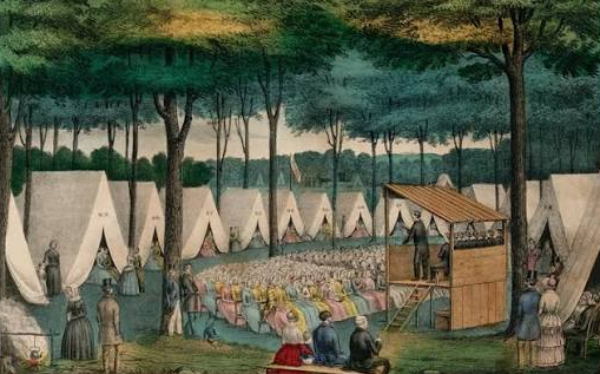
The Second Great Awakening (1790-1840) gained momentum with miraculous events at Presbyterian Sacramental Meetings and went on to become the greatest sustained evangelistic movement in American history, transforming America into the Evangelical powerhouse of the world. As the result of the Second Great Awakening, Christianity completely dominated the popular culture of America. By 1875, newspapers routinely printed human interest stories of evangelists, like the one in 1875 which reported D. L. Moody's amazement when he found a teenage girl in Chicago who had never heard of Christ.
|
The Old Light Calvinists were just as anti-revival in the Second Great Awakening as they had been in the First Great Awakening, but Calvinism in America had started to shift in 1768 when John Witherspoon brought Scottish Common Sense Realism to the College of New Jersey and removed the pro-revival teachers like Jonathan Edwards Junior who taught New England Theology. Some of the Presbyterian ministers educated at the College of New Jersey and schools started by ministers taught by Witherspoon, ended up finding out first-hand the foolishness of a theology that limited the Holy Spirit. One of these ministers was James McGready, who in 1800, held a Presbyterian Sacramental Meeting at Red River, Kentucky. Here's what happened: "multitudes were struck down under awful conviction; the cries of the distressed filled the whole house...A power which allowed of no resistance, came see-sawing over the whole house. In a few moments, the floors were covered with the slain; their screams for mercy pierced the heavens". Many Presbyterian ministers like Barton Stone who witnessed the miracles left the Presbyterian church altogether. If these ministers had been educated properly in New England theology, they could have understood the Westminster Confession in the same way Asahel Nettleton understood it, and could have had remained in the Presbyterian Church. All the issues regarding free will and the sovereignty of God are faced honestly in New England Theology. So why did Witherspoon want to replace supernatural regeneration and the indwelling of the Holy Spirit with a rational understanding of salvation? He thought the emerging field of science (called psychology today), would answer the question as to why some men are saved, but most are not. Remember, at the end of the 18th century, it was thought science would answer the question of moral depravity. This wasn't considered heresy any more than the theory of evolution by B.B. Warfield...it was just considered God's way of doing things, not a repudiation of the sovereignty of God. Ministers that promoted Scottish Common Sense Realism didn't see any departure from orthodoxy when they said 1) people are saved by the truth, and 2), the immediate activity of the Holy Spirit is not needed in regeneration. After 200 years of advances in psychology, there remains no scientific explanation for the miracles that happened at Presbyterian Sacramental Meetings.
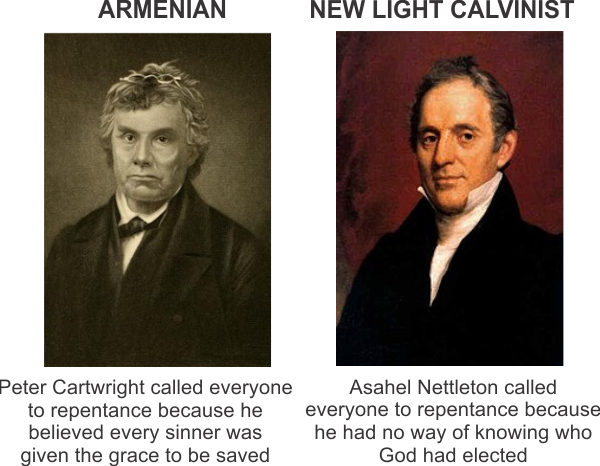
Peter Cartwright (1785-1872 and Asahel Nettleton (1783-1844) both believed saving grace was available to anyone who savingly repented of sin and savingly had faith in Christ. But Cartwright and Nettleton had two different views of how a sinner savingly repented of sin and savingly had faith in Christ. Cartwright believed before the world was created, God had ordained who would be saved (elected) based on His foreknowledge of who would respond to the grace given to all sinners to believe on the Lord Jesus Christ. Conversely, Nettleton had the view that before the world was created, God had ordained who would be saved (elected) based on His own foreknowledge of what would be best for His creation without regard for any decision made by sinners. Nettleton's view complied with Romans the ninth chapter: “Is there unrighteousness with God? Certainly not! For He says to Moses, 'I will have mercy on whomever I will have mercy, and I will have compassion on whomever I will have compassion.' So then it is not of him who wills, nor of him who runs, but of God who shows mercy”. (Romans 9:14-16). Good Christians like Cartwright have always, in every age, had a hard time with the Biblical view of election, the Apostle Paul included. Romans chapter nine is Paul’s explanation of the difficulty of accepting by faith that God is good at the same time He could have prevented evil. “You will say to me then, ‘Why does He still find fault? For who has resisted His will?’ But indeed, O man, who are you to reply against God? Will the thing formed say to him who formed it, ‘Why have you made me like this?' Does not the potter have power over the clay, from the same lump to make one vessel for honor and another for dishonor? What if God, wanting to show His wrath and to make His power known, endured with much longsuffering the vessels of wrath prepared for destruction, and that He might make known the riches of His glory on the vessels of mercy, which He had prepared beforehand for glory” (Romans 9:19-23).
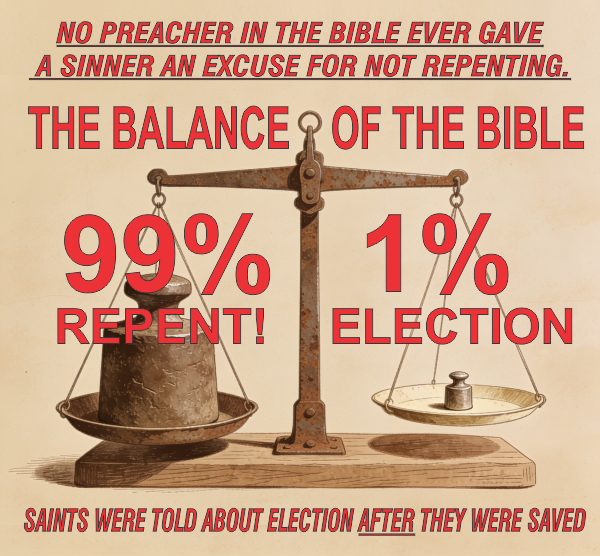
The defining features of the New Light Calvinist minister (as apposed to Calvinist ministers before the First Great Awakening), was he had no problem calling all sinners to repentance without the caveat of election. The seekers or penitants or inquirers would be examined in after-meetings or one-on-one in homes, or in Inquiry Rooms for evidence of the supernatural change caused by regeneration and the indwelling of the Holy Spirit. Up until Billy Sunday, no New Light Calvinists would tell hopeful converts that they were saved, and certainly not because of something they did such as being baptized, or repeating a prayer, or making a "decision for Christ". Both New Light Calvinists like Nettleton and Arminians like Cartwright still believed supernatural regeneration and the indwelling of the Holy Spirit as necessary for salvation. |
 |