
How The Presbyterian
Church Abandoning Supernatural
Regeneration and
the Indwelling of
the Holy Spirit
Relates to
the
Heresy of
Decisional Regeneration
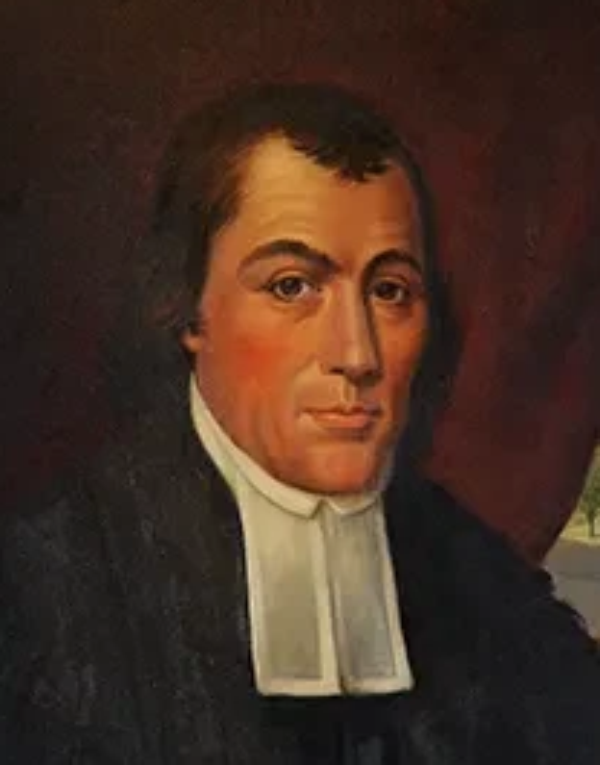 |
John Blair Smith (1756-1799) |
John Blair Smith (1756-1799) was a Presbyterian President of Hampden Sidney College of Virginia during the student revival of 1788. When Cary Allen (1767-1789) came back to school as a convert, Smith “was exceedingly fearful it was all a delusion, and put him through the most rigid examinations, set him to reading Joseph Bellamy’s True Religion Delineated and distinguished from all counterfeits.” Smith was fortunately regenerated early in life, so he was not debilitated by the Scottish Common Sense Realism of John Witherspoon when he attended the College of New Jersey (Princeton) before the Revolutionary War. Like all Evangelical ministers in New England before Scottish Common Sense Realism changed the salvation paradigm, Smith believed in supernatural regeneration and the indwelling of the Holy Spirit.. Smith was instrumental in the conversion of a student named Nash Legrand (1768-1814), and clearly saw his conversion and regeneration in the New England Way of Jonathan Edwards. But in 1854, Henry Foote (1794-1869) published in Sketches of Virginia, Volume 1, the Scottish Common Sense Realism view of the 1788 revival at Hampton Sydney College. Read the red. "Sudden conversions were then rather matters of suspicion than desire. Dr. Smith and others placed little confidence in sudden conversions…The change professed by Legrand was a consistent one; it was a change of principle and of feeling and conduct, all consentaneous, and visible. His temper and deportment were that of a Christian; and his professed views of the plan of a sinner's salvation by the renewing of the Spirit of God, and the atoning blood and righteousness of the Lord Jesus Christ, were as correct as any could give, and were the ground of his joy and rejoicing". "The effect of his sudden conversion and great joy, was peculiar, as in the case of Carey Allen, a few months previous. Others desired the same rapturous exercises; and sought the same preceding distressing views of themselves as sinners. They wished to feel such a load of conviction for sin as would crush them to the earth; and then such a sudden deliverance as would fill them with ecstatic joy and rejoicing. Many were the attempts to throw away all they had experienced before, begin anew, and get religion in the way Allen and Legrand had obtained theirs". "But it is foolish and dangerous to set up the experience of any man as a standard for all others; though the work is substantially the same in all, there is in nothing a greater diversity than in the circumstances attending the conversion of different persons. On the other hand it is equally weak and presumptuous to limit the Almighty as to the time required to convert the soul and regenerate the heart of the sinner". "In fact, we scarcely find in the New Testament any other conversions than sudden ones, as in the day of Pentecost, the succeeding preaching, in the case of the Eunuch and of Lydia and the jailor. This appears to have been the common mode of conversion in apostolic days. Conversion was precisely the same thing in those days that it is now, and effected by the same agency of the Divine Spirit, and not by miraculous operations. Miracles never yet converted a sinner". There are two rival students of John Witherspoon at the College of New Jersey (Princeton) who became Presidents of rival colleges. In the Virginia revival of 1788, John Blair Smith, a Bellamite, seamlessly worked with the Holy Spirit. William Graham, a Scottish Common Sense Realist, worked on the fringes of the revival, always looking for psychological explanations for religious affections. Allen’s conversion was the first of many, as students came under the influence of the Holy Spirit. Smith was able to able to co-labor with the Holy Spirit in that revival, “He advised those who were awakened not to be too hasty in professing conversion; and urged them to examine the foundations of their hopes well before they entertained a hope they had made their peace with God, stating it was a dreadful thing to be deceived in a matter of such importance. Generally months, and in some instances a year or more was suffered to pass before they were received into a church. No Anxious Seat, nor Inquiry Meetings were used or thought of in those days: but no opportunity was suffered to pass by without talking to such persons in the most plain and faithful manner”. Faith in psychology elevates Scottish Common Sense Realism William Graham (1746-1799) was a classmate of Smith at the College of New Jersey (Princeton) and later President of Washington College. Unfortunately, converted as an adult, he wholeheartedly adopted John Witherspoon’s Scottish Common Sense Realism. He taught students to see religious affections as empirical workings of the mind. “The science, however, which engaged his attention more than others, except theology, was the philosophy of the mind…the system of mental philosophy which he formed, was in cleverness and fullness superior to anything which had been given to the public…and it is greatly to be regretted that his lectures were never fully committed to writing”. It was this system that Graham passed onto students, especially Archibald Alexander. A writer in the August 1821 Evangelical And Literary Magazine wrote, “Doctor (John) Witherspoon , in an address to his class at the close of his lectures, observed that in mental philosophy there were difficulties which the present state human knowledge did not enable us to solve; but he had no doubt the time would arrive, and perhaps at no distant day, when these difficulties would be removed, and we enjoy as much certainty and perspicuity (understanding) in moral as in natural philosophy.” Modern translation: “In understanding what causes man to sin and then stop sinning, these are difficulties which the present state human knowledge does not enable us to solve; but I have no doubt the time will come, and perhaps soon, when these difficulties would be removed, and we will have as much certainty and understanding of what causes man to sin and stop sinning as we have of how physical things work..” This faith in psychology Witherspoon passed onto William Graham, who passed it onto Archibald Alexander. The article continued… “Mr. Graham immediately, as he expressed it – felt his heart burn within him. Oh- said he to himself – that I might live to see the day!” |
 |