
How John Fletcher
Relates to the
Heresy of Decisional Regeneration
John William Fletcher (1729-1785)
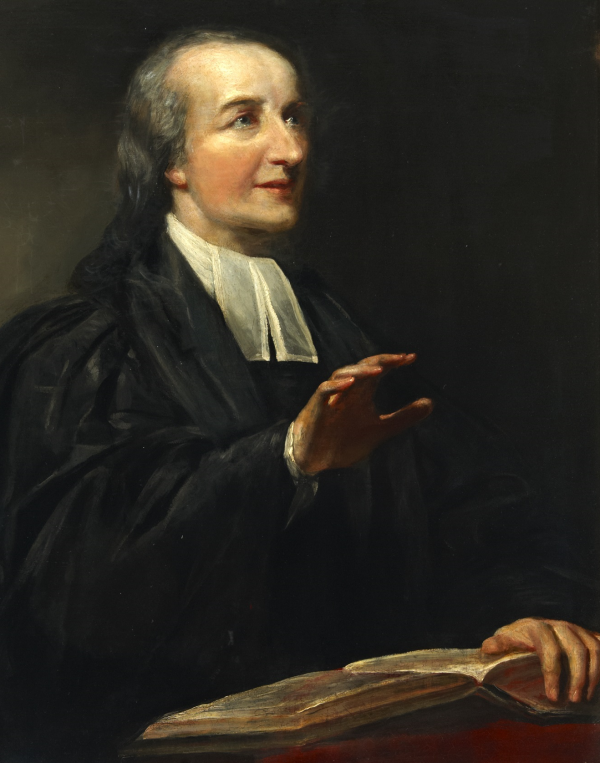
How John Fletcher John William Fletcher (1729-1785)
|
|
John William Fletcher (1729-1785) was perhaps the most effective public advocate of the teachings of John Wesley's beliefs. He's cited by "deeper life" Christians as one of the best examples of holiness of his day. He is featured here because like many born after the Enlightenment, he couldn't reconcile predestination with the free will of man, and to appease his conscience, decided that Scriptures that he felt depicted God as unjust (according to his rational understanding), would best be treated as "obscure". Fletcher is a good example of the post-enlightenment practice of chosing to ignore the clear teaching of 1% of Scriptures dealing with the sovereignty of God because they seem at odds with 99% of Scriptures that tell sinners to repent without caveat. John Fletcher defended John Wesley’s ideas in 1771 The RED passage below is where Fletcher uses the claim that certain Scriptures are “obscure” as an argument. He prefers to adhere to “the laws of candor and criticism”, that is, rational logic, over faith in the Word of God. “The natural (soulish) man does not receive the things of the Spirit of God, for they are foolishness to him; nor can he know them, because they are spiritually discerned” (1 Corinthians 2:14). “As a true son of the Church of England, he (John Wesley) believes that "Christ redeemed him and all mankind;” that "for us men,"' and not merely for the elect, " He came down from heaven, and made upon the cross, a full, perfect, and sufficient sacrifice, oblation, and satisfaction for the sins of the whole world." Like an honest man, and yet a man of sense, he so subscribed the Seventeenth Article (1) as not to reject the Thirty-first (2), which he thinks of equal force, and much more explicit ; and therefore, as the Seventeenth Article authorizes him, he "receives God’s promises in such wise as they are generally set forth in the Holy Scriptures;" rejecting, after the example of our Governors in Church and State, the Lambeth Articles, in which the doctrine of absolute, unconditional election and reprobation was maintained, and which some Calvinist Divines, in the days of Queen Elizabeth, vainly attempted to impose on these kingdoms, by adding them to the Thirty-nine Articles. Far, therefore, from thinking he does not act a fair part, in rejecting the doctrine of particular redemption; he cannot conceive by what salvo the consciences of those ministers, who embrace it can permit them to say to each of their communicants, "The blood of Christ was shed for thee;"' and to baptize promiscuously all children within their respective parishes, "in the name of the Father, and of the Son, and of the Holy Ghost,” when all that are unredeemed have no more right to the blood, name, and Spirit of Christ, than Lucifer himself. Thus far Mr. W agrees with Arminius, because he thinks that illustrious Divine agreed thus far with the Scriptures, and all the early Fathers of the Church. But if Arminius (as the author of Pictas Oxoniensis affirms in his letter to Dr. Adams) “denied that man’s nature is totally corrupt; and asserted that he hath still (3) a freedom of will to turn to God, but not without the assistance of grace;" Mr. W. is no Arminian, for he strongly asserts the total fall of man; and constantly maintains that by nature man’s will is only free to evil, and that divine grace must first prevent, and then continually further, him, to make him willing and able to turn to God. I must, however, confess that he does not, as some real Protestants, continually harp upon the words FREE grace, and FREE will; but he gives reasons of considerable weight for this. 1. Christ and his Apostles never did so. He is therefore persuaded; the most complete system of Divinity is that in which neither of those two axioms is superseded. He thinks it is bold and unscriptural to set up the one at the expense of the other, convinced that the Prophets, the Apostles, and Jesus Christ, left us no such precedent; and that, to avoid what is termed legality, we must not run into refinements which they knew nothing of, and make them perpetually contradict themselves: Nor can we, he believes, without an open violation of the laws of candor and criticism, lay a greater stress upon a few obscure and controverted passages, than upon an hundred plain and irrefragable (irrefutable) Scripture proofs. He, therefore, supposes that those persons are under a capital mistake, who maintain only the first Gospel-axiom; and, under pretense of securing to God all the glory of the salvation of one elect, give to perhaps twenty reprobates full room to lay all the blame of their damnation, either upon their first parents, or their creator. This way of making twenty real holes, in order to stop a supposed one, he cannot see consistent either with wisdom or Scripture. Editors Note: While I agree that 99% of the Bible calls all sinners to repent without caveats, I would never refer to the 1% of Scriptures that deal with the sovereignty of God in all things as “obscure”, especially those that clearly state that election is of God before the creation of the world. To call 1% of the Bible “obscure” calls into question whether the remaining 99% could be considered obscure also if one chose to designate it so. Anyone that doesn’t believe 100% of the Bible, despite the inability to reconcile some scriptures with others, is ultimately, a fool. He fashions a god he’s comfortable with, but knows his faith is based on doubting that certain Scriptures are true. If you are to have peace, you must take the stand of the Apostles…they trusted God is good, even though they could not reconcile certain things rationally. The Apostle Paul knew the truth of predestination was offensive to rational man. In the 9th chapter of Romans, he wrote, “When Rebecca also had conceived by one man, even by our father Isaac (for the children not yet being born, nor having done any good or evil, that the purpose of God according to election might stand, not of works but of Him who calls), it was said to her, “The older shall serve the younger.” As it is written, “Jacob I have loved, but Esau I have hated.” PAUL KNEW when he wrote this, some of the gentiles in the church would have a BIG problem with it. HE DOESN’T BACK DOWN…HE EXPECTED THEM TO BELIEVE THE BIBLE TO BE TRUE despite their inability to understand rationally how a good God could operate this way. “What shall we say then? Is there unrighteousness with God? Certainly not! For He says to Moses, “I will have mercy on whomever I will have mercy, and I will have compassion on whomever I will have compassion.” So then it is not of him who wills, nor of him who runs, but of God who shows mercy” (Romans 9:10–16). If you consider some Scriptures to be “obscure” enough to discount, you deny the very basis of faith in the Word of God. The only way to have peace is to believe Scriptures are true BY FAITH, not rational understanding. Paul put it this way: “The natural (soulish) man does not receive the things of the Spirit of God, for they are foolishness to him; nor can he know them, because they are spiritually discerned” (1 Corinthians 2:14). Rational man naturally (soulishly) wants to believe the Bible is true. The writer of Hebrews says “faith is the substance of things hoped for, the evidence of things not seen” (Hebrews 11:1). Ultimately, we must trust the Word of God is true BY FAITH. The 99% message of the Bible is sinners need to repent. The 1% message of the Bible is God elects who will be saved. It is wrong to use the 1% to de-emphasize the 99% and visa-versa. David of the Bible said something like the "the film is in the can": "In Your book they all were written, The days fashioned for me, When as yet there were none of them" (Psalms 139:16). God told Jeremiah, "Before I formed you in the womb I knew you" (Jeremiah 1:5). The Apostle Paul called all sinners to repent, but he didn't do it at the expense of the 1%: "Being predestined according to the purpose of Him who works all things according to the counsel of His will" (Ephesians 1:11). "For whom He foreknew, He also predestined to be conformed to the image of His Son" (Romans 8:29). "He chose us in Him before the foundation of the world, that we should be holy and without blame before Him in love, having predestined us to adoption" (Ephesians 1:4-5). "Who has saved us and called us with a holy calling, not according to our works, but according to His own purpose and grace which was given to us in Christ Jesus before time began" (2 Timothy 1:9).The Apostle Peter called all sinners to repent, but didn't do it at the expense of the 1%: "Elect according to the foreknowledge of God" (1 Peter 1:2). Just because we can shave our heads, that doesn't make the words of Christ any less true: "Are not two sparrows sold for a copper coin? And not one of them falls to the ground apart from your Father’s will. But the very hairs of your head are all numbered" (Matthew 10:29-30). Those who choose not to believe on the Lord Jesus Christ are those "whose names have not been written in the Book of Life of the Lamb slain from the foundation of the world" (Revelation 13:8). Faith is not identical to reason. We must believe everything in the Bible in order to have a clear conscience. If our reason is at odds with what's in the bible, we need to remember, "the natural (soulish) man does not receive the things of the Spirit of God, for they are foolishness to him; nor can he know them, because they are spiritually discerned" (1 Corinthians 2:14). Footnote 1) Article 17 of the Church of England. Predestination to Life is the everlasting purpose of God, whereby (before the foundations of the world were laid) he hath constantly decreed by his counsel secret to us, to deliver from curse and damnation those whom he hath chosen in Christ out of mankind, and to bring them by Christ to everlasting salvation, as vessels made to honour. Wherefore, they which be endued with so excellent a benefit of God be called according to God's purpose by his Spirit working in due season: they through Grace obey the calling: they be justified freely: they be made sons of God by adoption: they be made like the image of his only-begotten Son Jesus Christ: they walk religiously in good works, and at length, by God's mercy, they attain to everlasting felicity. As the godly consideration of Predestination, and our Election in Christ, is full of sweet, pleasant, and unspeakable comfort to godly persons, and such as feel in themselves the working of the Spirit of Christ, mortifying the works of the flesh, and their earthly members, and drawing up their mind to high and heavenly things, as well because it doth greatly establish and confirm their faith of eternal Salvation to be enjoyed through Christ, as because it doth fervently kindle their love towards God: So, for curious and carnal persons, lacking the Spirit of Christ, to have continually before their eyes the sentence of God's Predestination, is a most dangerous downfall, whereby the Devil doth thrust them either into desperation, or into wretchlessness of most unclean living, no less perilous than desperation. Furthermore, we must receive God's promises in such wise, as they be generally set forth to us in holy Scripture: and, in our doings, that Will of God is to be followed, which we have expressly declared unto us in the Word of God. Footnote 2) Article 31 of the Church of England. The Offering of Christ once made is that perfect redemption, propitiation, and satisfaction, for all the sins of the whole world, both original and actual; and there is none other satisfaction for sin, but that alone. Wherefore the sacrifices of Masses, in the which it was commonly said, that the Priest did offer Christ for the quick and the dead, to have remission of pain or guilt, were blasphemous fables, and dangerous deceits. Footnote 3) This is Fletcher’s footnote. This is worded in so ambiguous a manner, as to give readers room to think that Arminius held man hath a will to turn to God before grace prevents him, and only wants some divine assistance to finish what nature has power to begin. In this sense of the words it is I deny Mr. W. is an Arminian.
|
 |
To Contact the Author, click here