How New Light Calvinists
Relate to
the
Heresy of
Decisional Regeneration
|
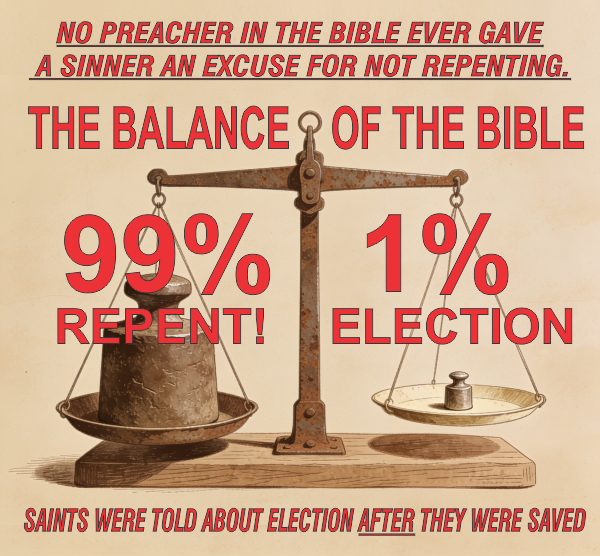
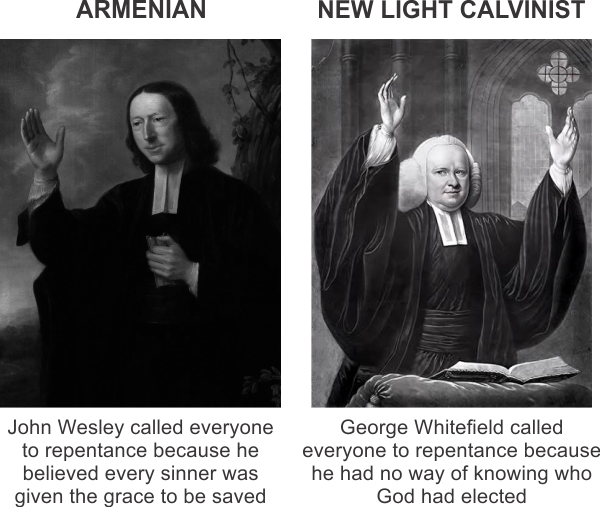
New Light Calvinism began in the First Great Awakening. Up until that point, Calvinists were less likely to call people to repentance without balancing it with the caveat that only those God regenerates can savingly repent. The irony is preachers in the Bible NEVER mentioned that caveat. Both George Whitefield and John Wesley told sinners "REPENT" without telling them they wouldn't be able to savingly repent unless God gave them special grace to do so.
John Wesley and George Whitefield both believed saving grace was available to anyone who savingly repented of sin and savingly had faith in Christ. But Whitefield and Wesley had two different views of how a sinner savingly repented of sin and savingly had faith in Christ. Wesley believed before the world was created, God had ordained who would be saved (elected) based on His forknowledge of who would respond to the grace given to all sinners to believe on the Lord Jesus Christ. Conversely, Whitefield had the view that before the world was created, God had ordained who would be saved (elected) based on His own forknowledge of what would be best for His creation without regard for any decision made by sinners. Whitefield's view complied with Romans the ninth chapter: “Is there unrighteousness with God? Certainly not! For He says to Moses, 'I will have mercy on whomever I will have mercy, and I will have compassion on whomever I will have compassion.' So then it is not of him who wills, nor of him who runs, but of God who shows mercy”. (Romans 9:14-16). Good Christians like Wesley have always, in every age, had a hard time with the Biblical view of election, the Apostle Paul included. Romans chapter nine is Paul’s explanation of the difficulty of accepting by faith that God is good at the same time He could have prevented evil. “You will say to me then, ‘Why does He still find fault? For who has resisted His will?’ But indeed, O man, who are you to reply against God? Will the thing formed say to him who formed it, ‘Why have you made me like this?' Does not the potter have power over the clay, from the same lump to make one vessel for honor and another for dishonor? What if God, wanting to show His wrath and to make His power known, endured with much longsuffering the vessels of wrath prepared for destruction, and that He might make known the riches of His glory on the vessels of mercy, which He had prepared beforehand for glory” (Romans 9:19-23).
The defining features of the New Light Calvinist minister (as apposed to Calvinist ministers before this time), was he had no problem calling all sinners to repentance without the caveat of election. The seekers or penitants or inquirers would be examined in after-meetings or one-on-one in homes, or in Inquiry Rooms for evidence of the supernatural change caused by regeneration and the indwelling of the Holy Spirit. Up until Billy Sunday, no New Light Calvinists would tell hopeful converts that they were saved, and certainly not because of something they did such as water baptism, or repeating a prayer, or making a "decision for Christ". The reason George Whitefield and John Wesley were both barred from preaching in Anglican churches, even though they were ordained as priests in the Anglican (Episcopal in America) church was they told Anglicans "repent!" and "you must be born again!", even if they had been baptized as infants. Insisting that all Christians need to be supernaturally regenerated and filled with the Holy Spirit with identifiable evidence is what it used to mean to be an evangelical Christian. New Light Calvinists in America continued to believe in the "New England Way" of distinguishing between regenerate and non-regenerate up until the 20th century. The New England Puritan view of Christian salvation as being a supernatural change of heart and the indwelling of the Holy Spirit was expected to be evidenced by a change of character. Duty faith was practiced by unregenerate Christians while faith working through love" was practiced by regenerate Christians. Jonathan Edwards and his disciples Bellamy, Hopkins and Emmons adapted the New England salvation theology to include a distinction between the sinner's natural ability and moral inability to choose God over self. Supernatural regeneration and the indwelling of the Holy Spirit was still necessary for the change of disposition from the born again experience, but by arguing that humans have the natural capacity to believe, but lack the moral desire, New England theologians maintain that God remains fully sovereign in salvation while sinners remain completely responsible for their refusal to repent. |
 |