How Old Light Calvinists
Relate to
the
Heresy of
Decisional Regeneration
|
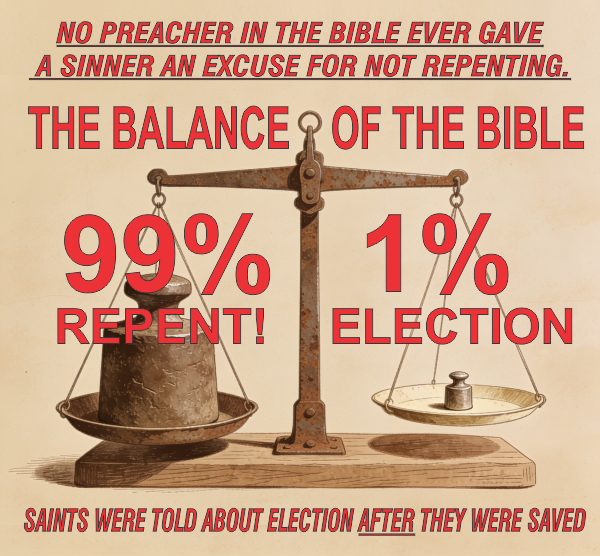
New Light Calvinism began in the First Great Awakening, so there were no Old Lights until then. The main innovation of the New Lights was the calling of sinners to immediate repentance. Most Calvinists before the First Great Awakening called sinners to repent, but warned them they would have to wait until God regenerated their hearts. The irony is preachers in the Bible NEVER mentioned that caveat.
Before the First Great Awakening, Calvinists were quick to condemn Arminian preachers for causing false conversions by telling sinners to repent without telling them they could only do this if God had regenerated them. But now New Light Calvinists preachers were doing the same thing, except with very different reasons.
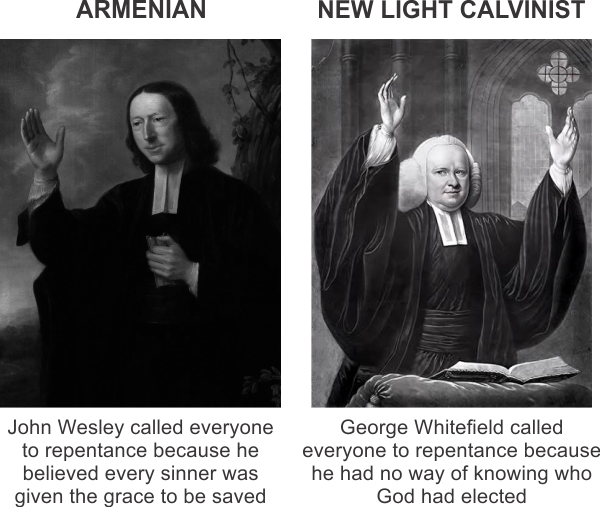
John Wesley and George Whitefield both believed saving grace was available to anyone who savingly repented of sin and savingly had faith in Christ. But Whitefield and Wesley had two different views of how a sinner savingly repented of sin and savingly had faith in Christ. Wesley believed before the world was created, God had ordained who would be saved (elected) based on His forknowledge of who would respond to the grace given to all sinners to believe on the Lord Jesus Christ. Conversely, Whitefield had the view that before the world was created, God had ordained who would be saved (elected) based on His own forknowledge of what would be best for His creation without regard for any decision made by sinners. Whitefield's view complied with Romans the ninth chapter: “Is there unrighteousness with God? Certainly not! For He says to Moses, 'I will have mercy on whomever I will have mercy, and I will have compassion on whomever I will have compassion.' So then it is not of him who wills, nor of him who runs, but of God who shows mercy”. (Romans 9:14-16). Good Christians like Wesley have always, in every age, had a hard time with the Biblical view of election, the Apostle Paul included. Romans chapter nine is Paul’s explanation of the difficulty of accepting by faith that God is good at the same time He could have prevented evil. “You will say to me then, ‘Why does He still find fault? For who has resisted His will?’ But indeed, O man, who are you to reply against God? Will the thing formed say to him who formed it, ‘Why have you made me like this?' Does not the potter have power over the clay, from the same lump to make one vessel for honor and another for dishonor? What if God, wanting to show His wrath and to make His power known, endured with much longsuffering the vessels of wrath prepared for destruction, and that He might make known the riches of His glory on the vessels of mercy, which He had prepared beforehand for glory” (Romans 9:19-23). The terms Old Light and New Light were first used during the First Great Awakening (1730–50), which took place in America and the British Isles. In A Faithful Narrative of the Surprising Work of God, written in 1737, Jonathan Edwards, a leader in the Awakening, describes his congregants' vivid experiences with grace as causing a "new light" in their perspective on sin and atonement. New Lights embraced the revivals that spread through the colonies, while Old Lights were suspicious of the revivals and the undermining of anti-revival ministers accused of not being saved. Many New Lights abandon the infant baptism of their Congregational, Presbyterian and Episcopal Churches, becoming Baptists, something George Whtefield never intended. In the Presbyterian Church, those who were pro-revival were sometimes called "New Side," and those who were anti-revival were called "Old Side". |
 |